Politics at Work: Corporate Mobilization
We have a clear image of corporate power. Big firms make lots of money and they use those profits to purchase politicians and dictate elections. At a time when Elon Musk is spending hundreds of millions of dollars on each election cycle, it’s an image that is difficult to shake.
The point of all that spending – on politicians, on turnout – is to keep someone in office. Or to get the votes necessary to prevent someone who might be oppositional to business out of office. Historically, shaping election outcomes was relatively straightforward – we only had a handful of media outlets considered credible, and parties and civil society organisers could act as focal points. Influence a focal point and you influence an election.
But now we’re in an era of hyper polarization and media bifurcation. Yet there is one social space that has remained intact through all of those changes – the workplace. Americans report spending more time at work than anywhere else. Couple that with weak labour markets, and a broader ethos of defining oneself by your job, and we get a recipe for political attachment.
In this post, I want to look beyond the conventional pay-to-play logics of corporate power and instead focus on the second-order effects of the workplace. Work is a site where individuals develop an understanding of their own political preferences and, most controversially, where they can be coerced into following dictatorial political mandates.
Socialization in the workplace
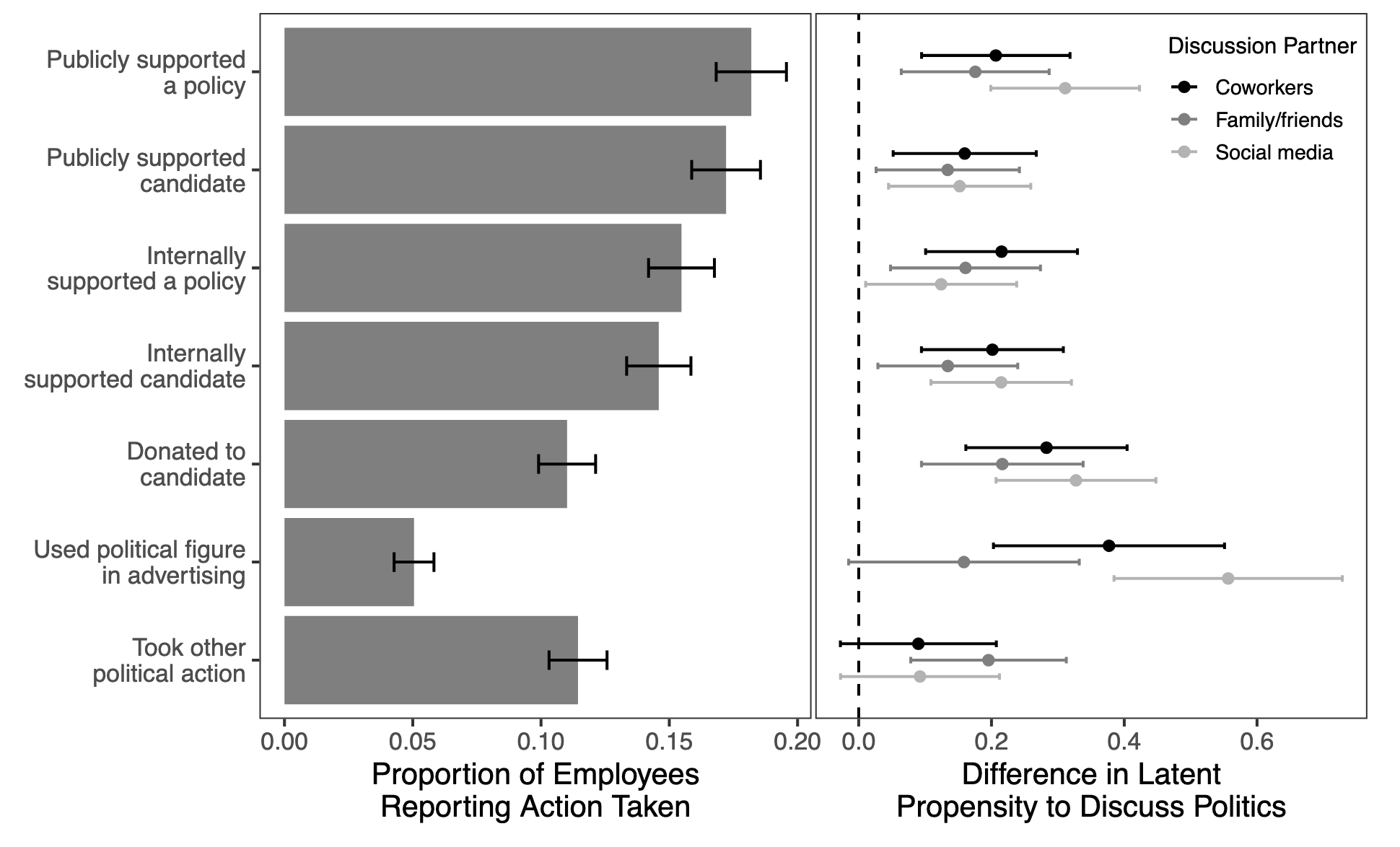
One of the most common tropes in American culture – readily depicted in the sitcom – is the fear of talking politics around the Thanksgiving dinner table. A recent working paper by Angell and Mehlhaff shows the need for an on-screen correction. The authors surveyed 3,050 American adults working at least 15 hours a week, in November 2025, and find that employees talk politics with coworkers at much lower rates than they do with family and friends.
But they can’t quite escape it. About 18% report their employer supporting a political candidate or policy in public-facing communications. Slightly fewer report similar statements inside the organisation while 11% say their employer donated to a campaign and 5% say it partnered with a political figure in advertising.
Workers don’t like it. Even among respondents who share their managers’ party, 63.3% believe that business should stay out of politics, and only 24.9% support their employer taking public stances. Some 55.5% of cross-pressured workers (where there’s a disjuncture between views at the top and their own) and 40.2% of aligned workers agree that firms should restrict political speech at work, as the Facebook and Google have tried in recent years.
Despite worker dismay, even just “talking politics” works. When a company’s execs engage in activism, their employees tend to participate more. Sharing a party with your firm, managers and coworkers consistently predicts more engagement, and there’s no evidence of a chilling effect from disagreeing. If anything, opposing your firm’s stance is associated with more frequent discussion.
Their survey experiments – where they show employees a mix of simply mentioning an issue versus a company taking a stance – show that the most efficient strategy to spur political engagement is to talk about political issues without taking a stance on them.
None of this should be too surprising given just that sheer amount of time we spend at work. We are the product of our interactions. In another working paper, Hurst et al. introduce the idea of “organizational civic culture,” meaning the norms and values within an organisation about participating in democratic institutions beyond the workplace, and test its effects with a dataset of 28 million American workers. They combine individual employment history from LinkedIn (via Revelio Labs) and administrative voter turnout records and find some dramatic effects.
They assess how moving workplaces, from a more or less politically engaged workplace (as measured by how much colleagues vote) changes the propensity of an individual to show up at the booths. A one-standard-deviation increase in coworkers’ voting rates raises a mover’s own likelihood of voting by 2.19 percentage points, a 6.81% increase on baseline turnout, across off-cycle, primary and general elections from 2013 to 2020. The effect works in both directions. Moving to a lower-turnout workplace also reduces voting. These are substantial effects when you consider that conventional political campaign strategies – like phone banks and canvassing - often produce effects of 1 percentage point or less.
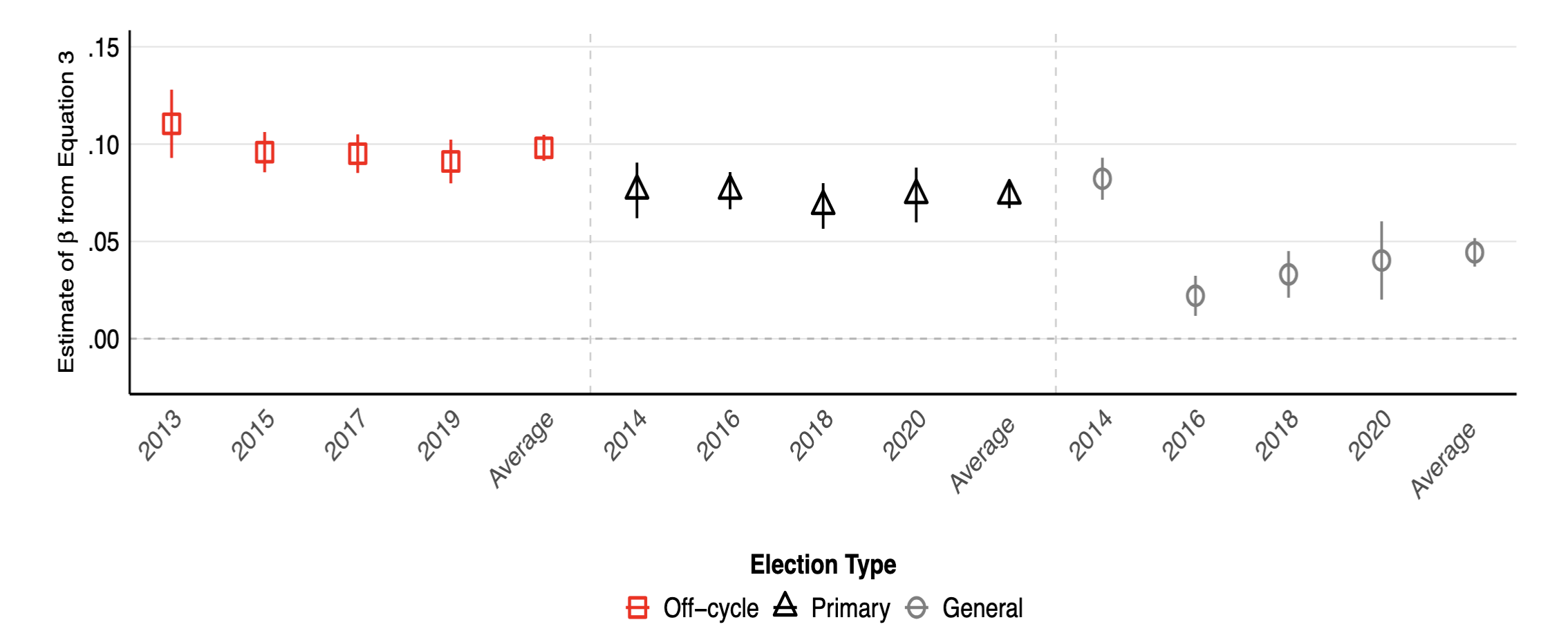
The figure above shows the pattern across election types. The effect is largest when turnout is conventionally lowest, providing some clear backing of their socialization mechanism. People are 2 percentage points more likely to show up in off-cycle elections (12.9% of baseline) per one-standard-deviation increase in coworker turnout, 1.58 in primaries (7.4%) and 1.15 in general elections (2.0%). The one exception is the 2014 midterm, where the general election effect was exceptionally high in a year with unusually low turnout. In other words, the workplace matters most where there’s the most room for it to matter.
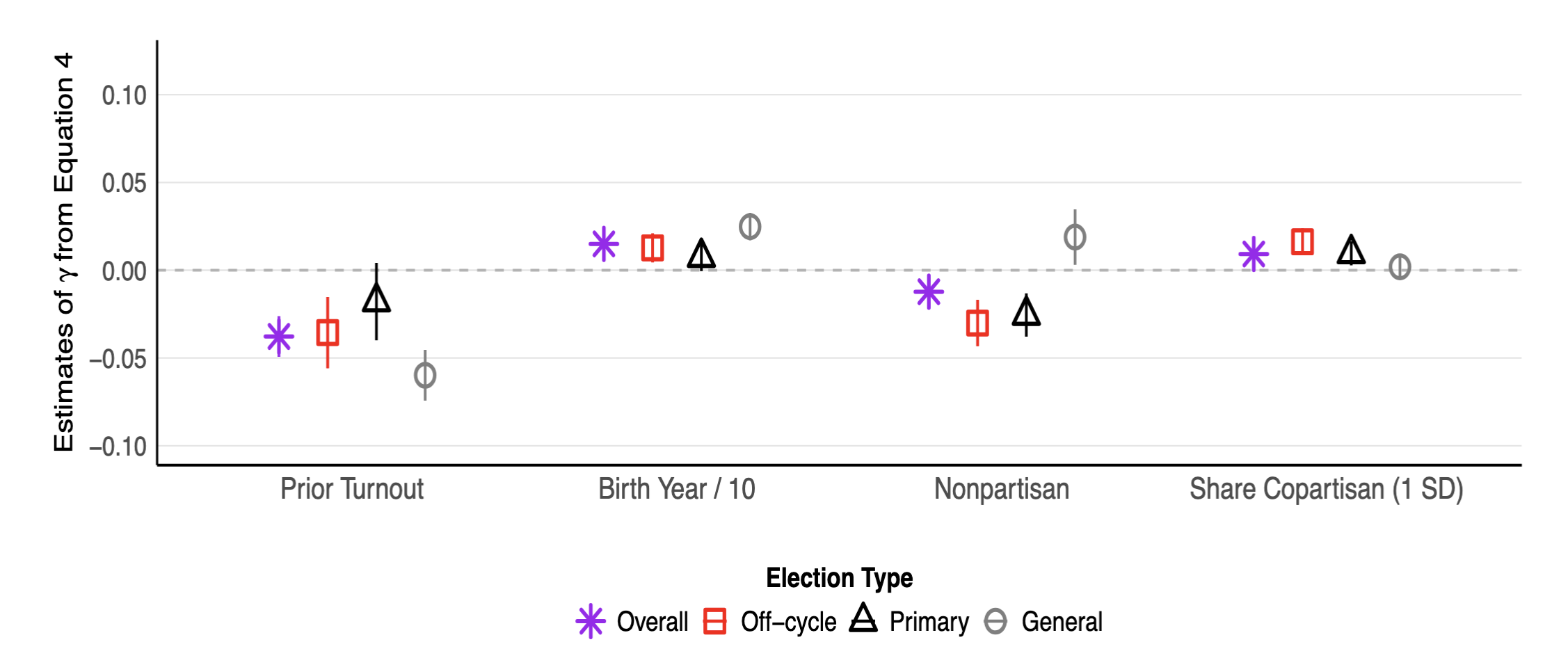
Effects are significantly smaller among workers who voted in the previous comparable election, and significantly larger among younger workers. Voting is habitual, so those who have already formed the habit are harder to move, and early-career workers are the most receptive to social influence. The flipside is that the workplace has the most influence over exactly the people who would otherwise stay out of democratic participation altogether.
But the spillover effects might be the most interesting. Using voter-file addresses, the authors identify at least one other household member for 1,579,804 movers (72% of the sample) and 2,749,394 household members in all. Household members become more likely to vote following the same ranking (largest off-cycle, smallest in general elections) but are smaller than the effects on the movers themselves, which fits civic norms diffusing from professional to personal spaces.
Beyond the Corporate Balance Sheet
The social effects described above do not sit with our neat mental models of corporate influence. We see firms that are busy throwing money around each and every political system, and yet political scientists often find themselves asking the opposite – Why is there such little money in (American) politics? That’s because, when you dive into the data, interest groups can give far more to campaigns than they actually do.
A corporate political action committee (PAC) can give up to $5,000 per candidate per election, yet in the 2016 cycle the average PAC sponsored by a public company gave $5,000 or more to only seven federal candidates, and the median was one.
So if access is for sale, why are there such few buyers? The common academic response is that the firms know something we don’t. It’s an indication that donations are an ineffective method that corporations have given up on. Zhao Li (2018) shifts the focus from returns to the politics of internal cohesion. A corporate PAC can’t draw on the company’s surplus. By law it has to raise its money from a restricted class of individuals (managers, shareholders, employees), and those people have politics of their own. Among PAC donors who have also given directly to candidates or parties, 77% have only ever given to one party.
The staple strategy for firms is to hedge their bets. They give to both sides to ensure that they have access no matter who is in charge.
But PAC donors are employees that are already highly politically engaged. Increased contributions to what an employee deems as “the other side” risks alienating the workforce. Li assesses this logic through a difference-in-differences design using PAC and donor giving records from 1990 to 2016, comparing donors of different partisan leanings within the same PAC. As a PAC raises the share of its giving going to one party, it loses donors who support the other. Through an original survey of 413 respondents, Li shows that 75% of employees know which party their PAC favoured, though the correlation between their guesses and the actual percentages is a modest 0.297.
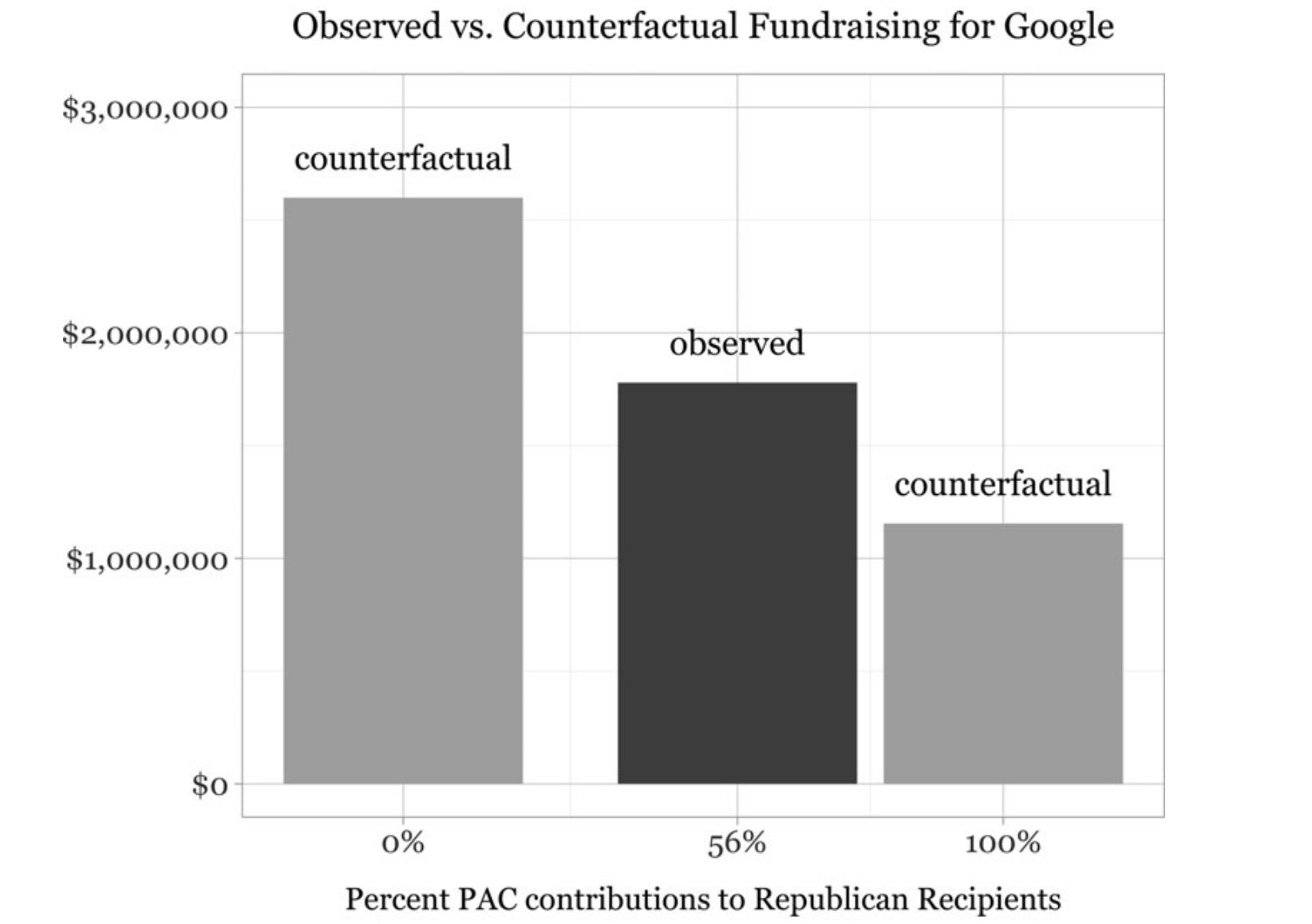
The Google example above shows how employees implicitly restrict corporate power. Between 2015 and 2016, about 55.7% of the company’s PAC contributions went to Republicans, and the PAC raised $1,778,775 in itemised donations. Had it given everything to Democrats – 84.3% of Google’s employee-donors lean Democratic - it would have raised $2,594,931, a 45.9% increase. Giving everything to Republicans would have cut that to $1,140,520, a 35.9% fall.
While Li shows us that employees can act as a check on corporate political actions, Jan Stuckatz (2022) shows how those employees are nonetheless strategic. He links the donations of employees and corporate PACs at 12,737 public companies from 2003 to 2018 and finds that 16.7% of all employee donation dollars (12.9% of rank-and-file dollars) go to candidates their company’s PAC also supports.That’s more than double a simulated counterfactual of similar candidates.
He tracks the same firm–legislator pair over time, which rules out industry, geography and long-standing party ties, analysing 9,032 firms and 1,089 legislators.The figure below shows what the difference-in-differences design exploits. PACs follow whoever holds Congress. From 2003 to 2006, with Republicans controlling the presidency and both chambers, PACs gave roughly 65% to Republicans and 35% to Democrats. After Democrats took both chambers in November 2006, the Democratic share rose to around 50%.
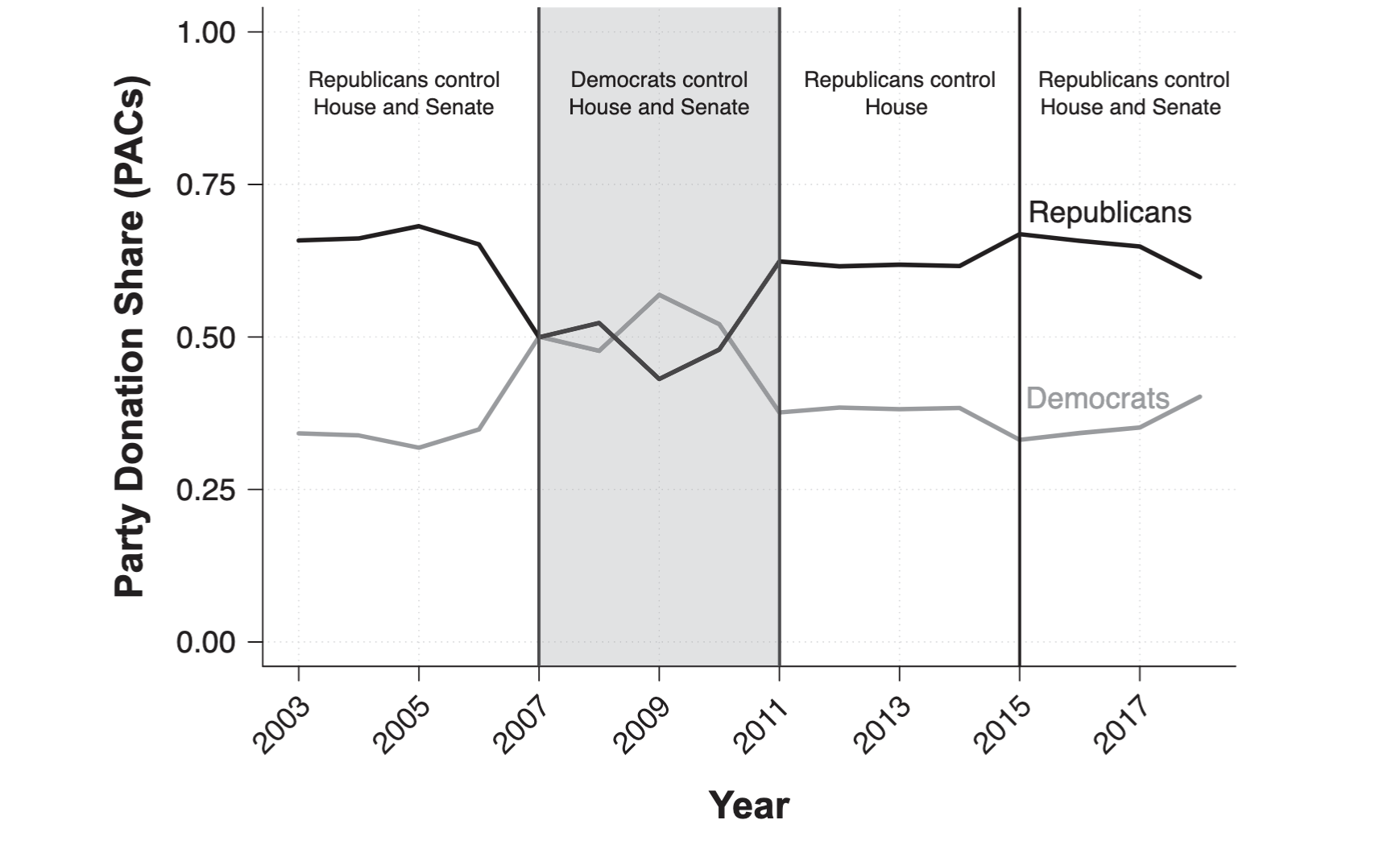
Employees move with them, with larger shifts among executives and more modest ones among rank-and-file donors.Employees give 17.4% more to a politician in the year their PAC does, 7.5% more the following year, and about nothing after that. These employee donations are means of self-preservation. People are most likely to follow their PAC by giving to committee chairs and politicians that are members of committees that regulate their industry. The effect is strongest when employees know what their bosses are doing. They donate more where the firm is more transparent about its preferences and for candidates endorsed by business associations.
Researchers often use individual donations to estimate people’s ideology, but if employees’ giving partly tracks their employer’s strategy, then those measurements may reflect corporate investment strategy instead. And, at first blush, it sits awkwardly with Li. But Li’s donors are the ones who already give to the PAC, a self-selected and partisan group, while Stuckatz tracks what employees do with their own candidate donations when the PAC moves.
Stuckatz finds no evidence of workplace pressure driving employee donations, though he’s careful to say he can’t observe it. Babenko et al. (2020) also can’t directly observe it, yet their findings point in that direction. Using S&P 1,500 firms from 1999 to 2014, they find that employees direct about three times more of their contributions to candidates their CEO supports than to other candidates, which works out at about $10,964 per firm. When the CEO changes, the employees’ giving changes with them.
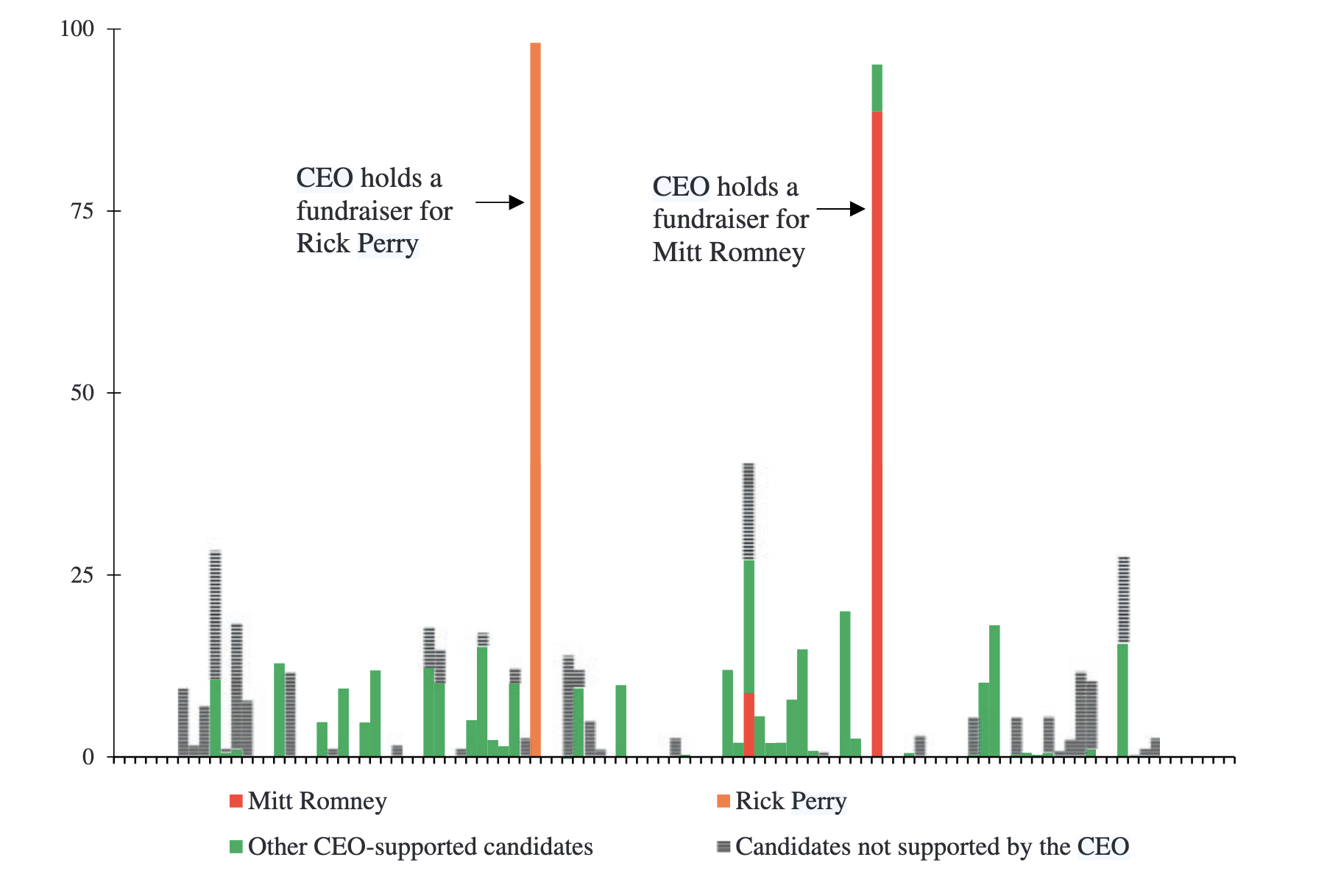
The best illustration is Murray Energy. No employee had given to Rick Perry before CEO Robert Murray hosted a fundraiser for him in September 2011. Right after the visit, employees gave close to $100,000. 95.5% of everything Perry and, later, Mitt Romney raised from Murray employees arrived within a week of the CEO advocating for them. Across the full sample, CEOs and employees gave about $317 million, 90% of it from employees. The CEOs skewed Republican (59% of their giving), while employees were split almost evenly.
The money pays direct dividends. The authors show that equity returns are higher when CEO-supported candidates win than when employee-supported candidates win, which suggests CEOs back the candidates who benefit the firm. But the misalignment comes with a price. A one standard deviation drop in overlap between an employee’s candidates and the CEO’s raises the probability that the employee leaves by about one percentage point, or 10.1% of the baseline turnover rate.
The authors consider three potential channels driving the giving. CEOs could be sharing credible information, offering rewards or potentially coercing their employees into supporting CEO/firm preferences. The authors look at the other members of an employee’s household and find 398 households in which people with the same last name and address gave to competing candidates for the same office, which means a loss for the household whichever one wins. If CEOs were just passing on information, there’d be no reason for this to correlate with the CEO’s behaviour. Yet household members are almost twice as likely to donate to competing candidates when their CEOs do (the unconditional rate is 30%). That’s hard to square with information, and easier to square with employees responding to incentives or pressure. The authors can’t say which. For that, we need the papers where pressure, rather than a privilege, is the point.
Corporate Coercion
Few individuals have taught us more about politics in the workplace than Alexander Hertel-Fernandez. He focuses on “employer mobilization” – the tactics that firms instrumentally use to force their employees into politics. His survey of 513 top managers found that 46% of firms reported doing at least one thing to recruit their workers into politics, from voter registration drives to endorsing candidates. About one in four workers said they had been contacted by top managers about politics on at least one occassion. Of the workers who were contacted, 47% said the messages changed at least one of their political practices or beliefs, most commonly turning out (32%) or registering to vote (24%). And these came accompanied with potential threats. 20% of contacted workers (5% of all workers) got a warning of job loss, plant closure or changes to wages and hours alongside the message. Manager expected that mobilizing employees would be as effective as hiring a lobbyist, and more effective than PAC contributions.
The Voting Rights Act (1965) bans intimidation in the voting process, and the Federal Election Campaign Act (1971) restricted partisan communication from top managers to rank-and-file workers. But Citizens United (2010) lets firms spend corporate resources on electoral politics, which includes employee time and effort, and private-sector workers have almost no protection against political discrimination. And the court ruling – while we tend to focus on its effects on campaign spending – has managed to birth an employee mobilization industry. The Business-Industry Political Action Committee (BIPAC) licenses a platform that helps managers send workers political information, and its client base grew from 50 organisations in 2000 to 7,317 in 2014, reaching around a fifth of the private-sector workforce.
Of workers contacted by their bosses about politics, only 47% agreed with their employer’s message, 28% had no opinion and 25% opposed it. Well over half reported at least one message that ran against their own politics, such as a liberal worker hearing from a conservative employer. The more blatant the ask, the more likely it came with a stick - workers who got candidate endorsements were three times more likely to report a warning of economic loss than workers who didn’t.
In the survey focused on managers, they admit as much. Of the firms that mobilize, 71% go beyond voter registration and turnout information to explicit material on candidates or policy, and the Business Roundtable estimates that the share of its members contacting workers about politics jumped from 18% in 2002 to 66% in 2004. A follow-up paper, Hertel-Fernandez (2017), asks why this would work, and borrows the old language of “political machines” that we associate with corrupt, clientelistic political parties. Think The Wire.
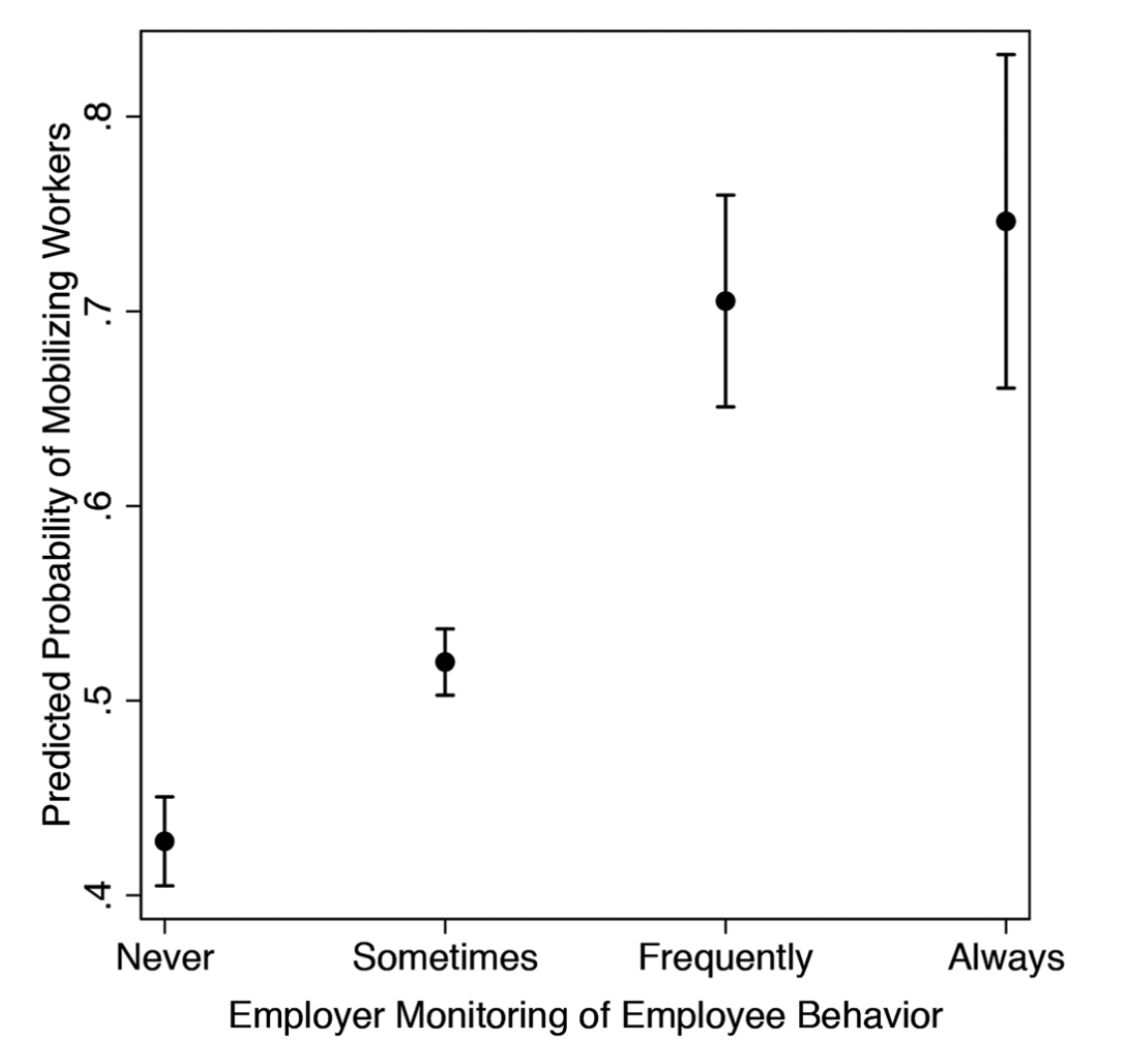
Machines influence voter turnout and voting patterns by deploying specific material rewards - buying votes - but since they can’t go into the booth with their clients they need to be able to monitor and possess a threat. A boss controls wages, hours and employment, and, as mentioned, the United States has no federal law against political discrimination at work. So the prediction is that workers who think their employer can see what they do will respond more, and that employers who can monitor will mobilize more.
Over a two-year window in the 2014 CCES, 5% of workers reported contact from their top managers, versus 7% from unions and 40% from parties or campaigns. The gap with the 25-30% who say they’ve “ever” heard from an employer is a matter of time frame, since firms don’t mobilize everyone every year. Employer requests nonetheless raised participation about as much as requests from unions and parties, and workers were most responsive when employers used warnings of job loss and when workers believed they could be tracked. About 34% of workers thought their employer could track their political behavior (23% excluding the unsure). On the firm side, 44% report some electronic monitoring and 13% frequently or always do, and firms that monitor more are more likely to mobilize.
The Boss as Broker
This is not an instance of American exceptionalism. Ironically, in the literature, the closest parallel is Russia. Frye et al. (2014) expand the thinking from just the employer-employee relationship to further consider government-employer bargains. Firms that can deliver votes cheaply, or that are vulnerable to pressure from the regime, are the most likely to try to mobilize. Workers who lack exit options, who are captured by their employer, are the ones mobilized.
Their initial surveys are close in spirit to Hertel-Fernandez’s, with higher numbers. Around the 2011 parliamentary elections, 24% of 922 firms in 15 regional capitals reported sanctioning political activity at the workplace, from endorsing a party and handing out campaign materials to hosting events. In a post-election Levada survey of 1,600 citizens, 25% of employed voters said their employer tried to influence their turnout, far more among government employees. An additional list experiment, which lets respondents report a sensitive item without identifying it, found that 15% believed their material standing would depend on whether they voted.
The firms that mobilize are the ones the state can plausibly squeeze. Heavy industry firms are 20 percentage points more likely than trade and service firms to mobilize workers, and so are state-owned firms and those that sell to the state. The conventional explanation is that holders of immobile assets, such as plants and mines, subvert democracy because they fear redistribution after free elections. The authors offer another flip of the script. Such firms are also the ones most vulnerable to the autocrat, and anecdotal evidence points to the second reading.
Regimes turning to the workplace follows a three-pong logic. Bosses can hand out significant carrots and sticks, including raises, benefits, shaming, delayed promotion and dismissal. They interact with workers repeatedly, which makes threats credible. And they can monitor turnout and potentially even break the secret ballot. In a survey after the March 2012 presidential election, 33% of workers thought their employer could find out how they voted.
In follow up work the authors (2019a) focus on the effectiveness of coercion, the stick. They ask when politicians use carrots and when they use threats, with list experiments embedded in a nationally representative survey of 1,600 Russians after the 2012 presidential election. Respondents were split three ways, each counting how many items on a list applied to them - a control group with four innocuous items, one with a vote-buying item added and one with an intimidation item. The findings clearly indicate that in the (Russian) workplace intimidation is more common than vote buying. 17% of employed respondents experienced intimidation by their employer, but it was not statistically detectable among the non-employed. The same pattern shows up in crowd-sourced violation reports collected by the election observer Golos, where 83% of reports about intimidation occurred in the workplace.
In single-company towns, where people lack other employment alternatives, 44% of employees report experiencing electoral intimidation. Again a list experiment shows how threat and monitoring trade off. Active monitoring was more common outside single-company towns. When the threat is severe enough, the boss doesn’t need to check, and where workers can find other jobs, intimidation needs supplementing with surveillance.
While these numbers are quite remarkable they raise an inevitable question. How do corporate machines compare to traditional political machines? Frye et al. (2019b) put them head to head, with framing experiments on 4,200 Russians after the 2014 regional elections and 1,400 Venezuelans after the 2016 parliamentary elections. Venezuela is a hard case for the employer hypothesis, since it has a recent history of strong grassroots party mobilization.
Respondents who got the employer-as-broker treatment were 6.1% more likely to vote than those who got the party treatment in Russia, and 9.3% more likely in Venezuela. The experiment also varied the tactic between a reward, an individual threat, a collective threat against the workplace or a plain request.
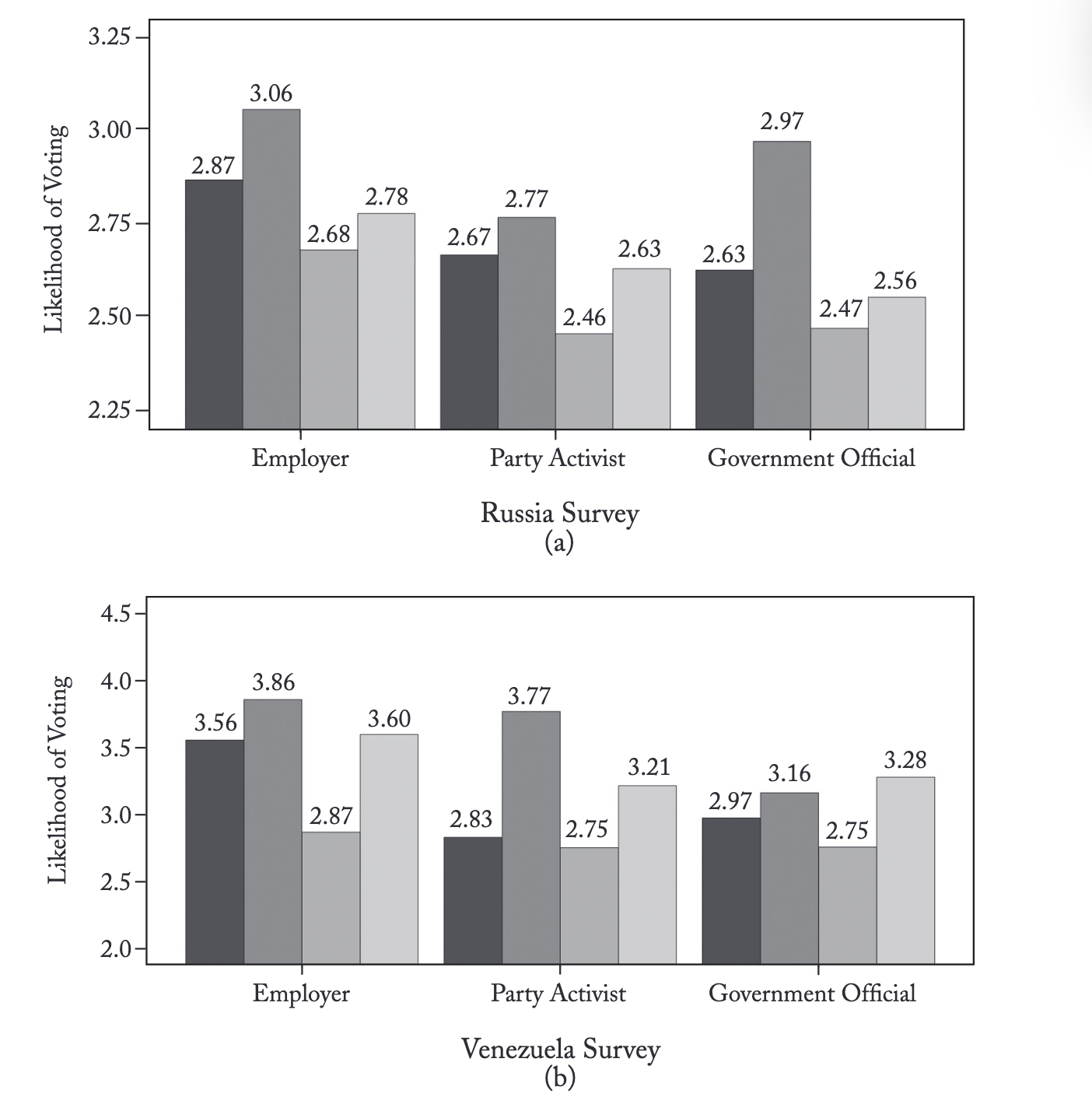
Despite nominally diverging contexts, the mechanisms fall in-line with Hertel-Fernandez. Voters respond more to employers when they fear losing their job, worry about finding comparable work and rely on the employer for in-kind benefits such as health insurance and childcare. Workers with a personal relationship with their employer, and those with longer tenure – those who can be most easily monitored - are more responsive.
Kubinec (2018) takes this line of reasoning to the Middle East, surveying 2,496 employees in Algeria, Egypt and Tunisia. Between 7 and 10% report that their firms donate to political parties, and between 7 and 13% that their bosses told them to vote for a specific candidate. The rates for Algeria and Tunisia sit in line with the US. The standout is Egypt, where 12.5-13.5% of firms did so, a lower bound given how sensitive the question is. That matters because turnout in Egypt’s 2015 parliamentary election was only 26%.
In Egypt, a single powerful actor, the military, is able to punish firms that defect from the dominant coalition. It has far greater economic penetration than its counterparts in Tunisia or Algeria, and support for it extends beyond firms with direct ties to it. In Tunisia, where no one can enforce coalition discipline, firm political activity tracks individual incentives such as benefits from circumventing regulation, and the coalition is more likely to fracture. Kubinec’s reading is that Egyptian firms have little choice but to act as agents of the regime, delivering a low-cost means of social compliance.
Companies are a means for people to make a living. They are also where we spend a disproportionate share of our time. The latter has the potential to reshape political preferences. The former – for the most part – means that firms have the potential to use their workforce as a political tool. Usually, that’s to push the firm’s agenda, but in contexts where even employers are captured, that means pushing the prerogatives of the state.