Politics at Work: Partisanship inside the Firm
2016 had its fair share of notable political events, but few could have expected that North Carolina would deliver one of the most memorable. That was the year NC passed HB2, the “bathroom bill” requiring transgender people to use the bathroom matching the sex on their birth certificate. The corporate response was also quicker than most would have expected - nearly 100 public company CEOs, and more than 150 corporate leaders in all, signed a statement opposing the bill. The NBA even moved its All Star game out of Charlotte. The response is largely considered one of the coming out parties for a more progressive corporate America, and that inadvertently turned into a boon for academics.
My previous post asked which party corporate America belongs to. The broad-strokes answer is that the top has turned purple, leaders think their firms are drifting left, and workplaces are sorted by party. This post instead looks at how political differences inside the firm spill out.
Who Gets the Firm to Speak?
There are two basic explanations for why corporations would put their reputations on the line and wade into social controversies. A top-down version says firm actions embody the CEO’s or the top management team’s values while the bottom-up one, borrowed from social movement theory, says firm activism reflects what employees want. McKean and King (2024) propose a middle-ground based on consistency across the top and the bottom.
The authors track 1,328 US public companies across four progressive letter campaigns in 2016 and 2017 - North Carolina's HB2, the Paris Climate Agreement, the 2017 travel ban and the DREAM Act. Together the letters drew more than 2,000 signatures from firms, CEOs and other company representatives. Ideology comes from 2014 and 2015 FEC donations by CEOs, top-management, and employees, grouped by employer into a scale from 0 (conservative) to 100 (liberal).
“Alignment” is a binary flag for whether both the top and the employees sit above a cutoff of 50, 60 or 70. The models control for CEO power (tenure, founder status, chair duality, pay), the share of an industry’s firms that signed, the headquarters state’s party and whether the firm has won employer awards.
The CEO’s own ideology has no independent association with signing. The overall top management’s ideology shows some association, but the firm characteristic most consistently linked to signing is liberal alignment between the top management team and employees.
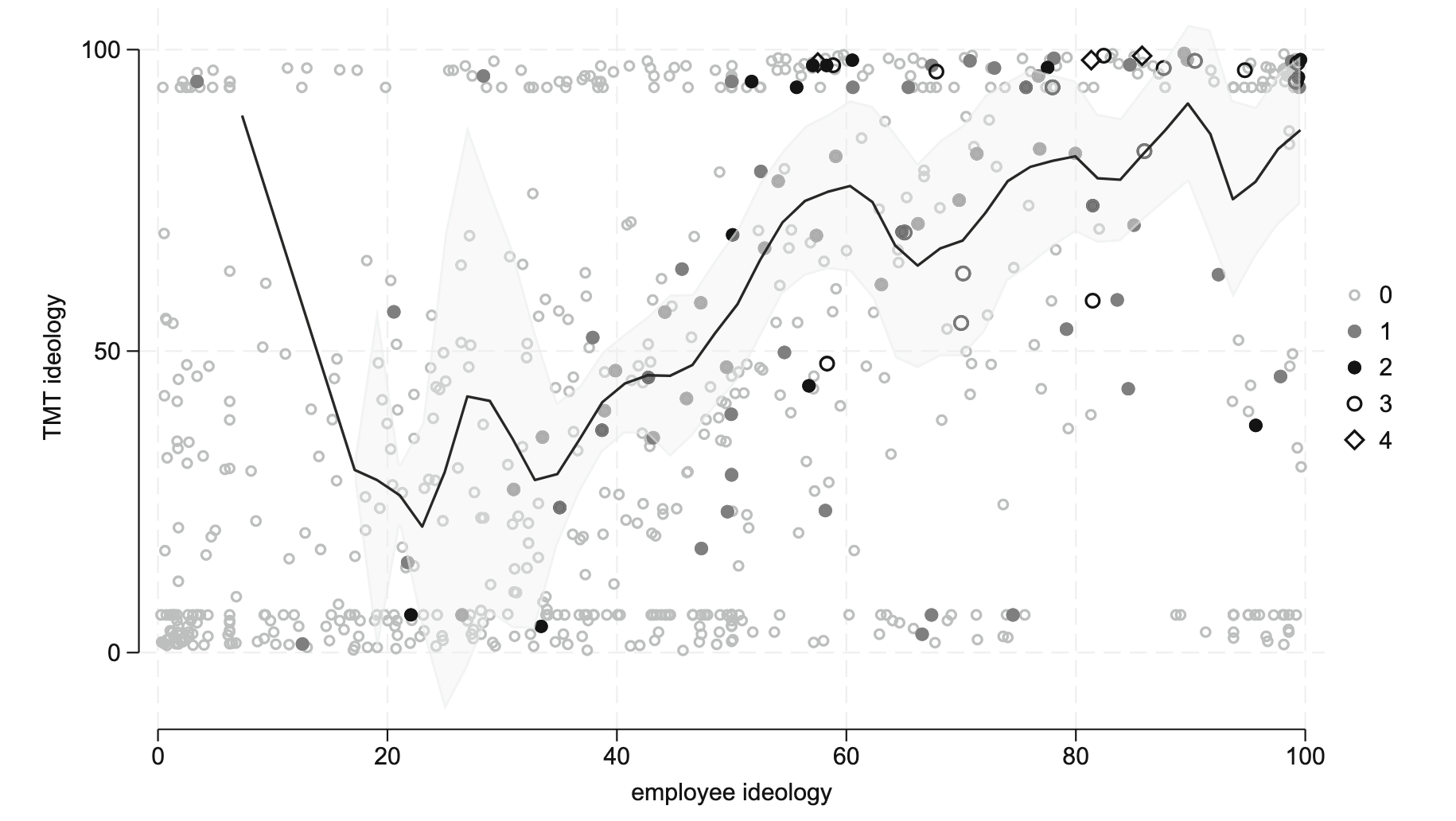
The figure above plots employee ideology (x-axis) against the top management’s ideology (y-axis), with a local polynomial fit and firms at the neutral midpoint of 50 dropped for clarity. Most firms that signed more than one letter sit in the upper-right quadrant, where both groups lean liberal. This fits Steel’s finding from my last post that firms with more conservative directors and executives are much less likely to sign the HRC statement. Employee backlash does appear to be a serious deterrent to corporate activity, even controlling for the free reign a CEO may have.
(How much) Do Employees Care?
Wowak et al. (2022) take the HB2 letter and compare firms whose CEOs signed vs. firms whose CEOs didn’t, looking at two outcomes. The first is employee commitment, measured from Glassdoor’s overall rating. They average ratings entered between April and December 2015 and between April and December 2016, so the before and after scores rest on entirely distinct sets of reviews. The second is employee support for liberalism, measured by the share of employee donations going to Democratic recipients. The key moderator is how liberal the workforce already was, again from employee donations (2012 to 2015, OpenSecrets). Since CEOs choose whether to sign, they instrument for signing with the average number of outside boards the firm’s directors sit on (more connected firms sign) and the dispersion of analyst recommendations (opaque firms don’t), and both predict signing in the first stage.
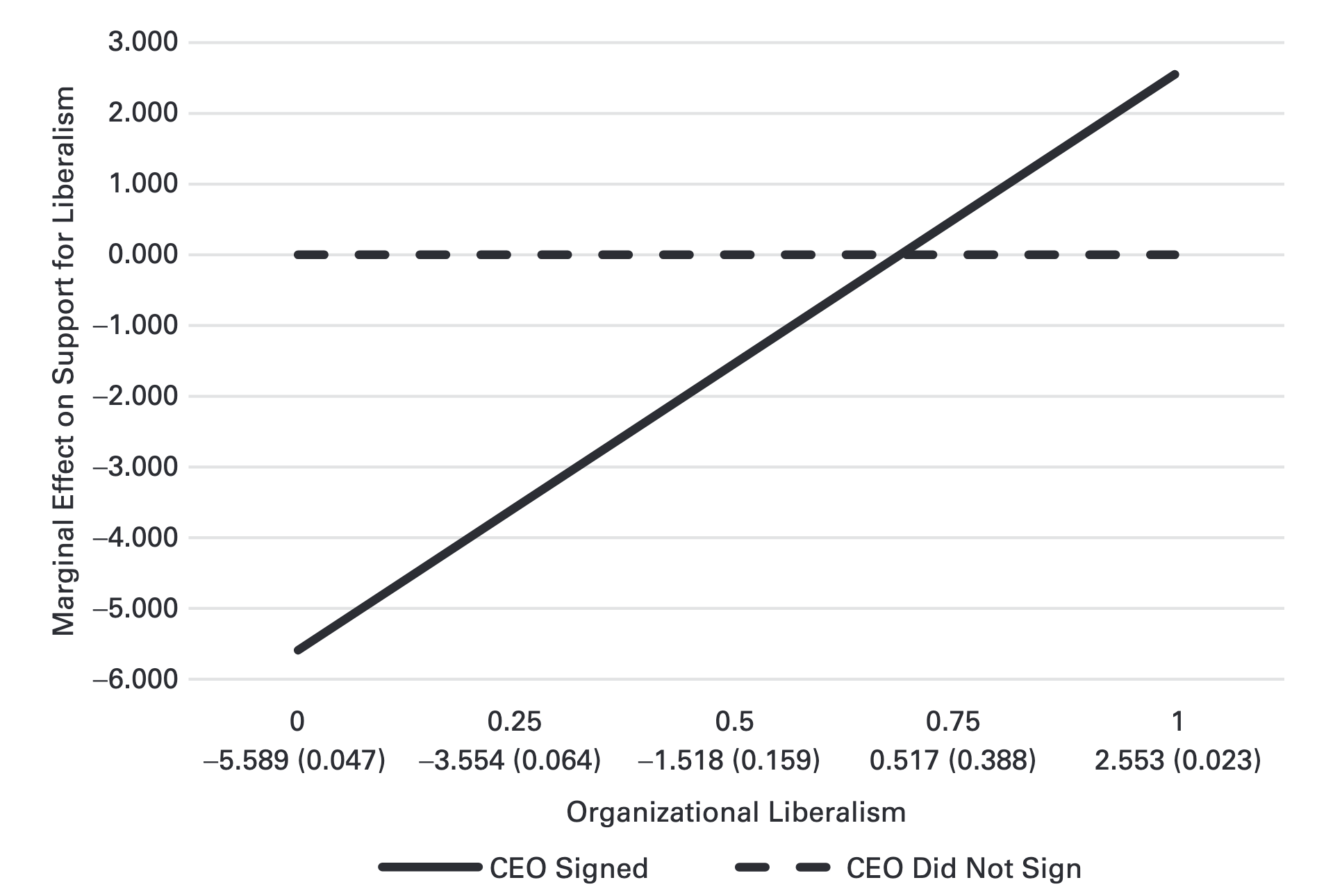
The figure above plots the effect of signing against the firm’s ex ante liberalism, and the line rises steadily. In highly conservative firms, signing reduced employee support for liberalism (-5.589, p = .047), as it did in somewhat conservative ones (-3.554, p = .064). The effect crosses zero for moderate firms and turns positive in highly liberal ones (+2.553, p = .023). The authors see this as pretty remarkable - a CEO’s stance moves not just views on the issue at hand but employees’ support for a party.
Two credibility measures further the story. A “prototypical” CEO (long tenure, ideology close to the workforce) amplifies the effects. But a highly regarded CEO, measured by Glassdoor approval, dampens them, which the authors read as a contrast effect. Lower-regarded CEOs make a bigger splash when they speak – cutting against expectations has the biggest impact.
Mkrtchyan et al. (2024) put the spillovers in broader social context. They hand-collected 1,402 instances of CEO activism at S&P 500 firms from news articles and Twitter. By topic, 32% were about diversity, 35% the environment, 7% politics and 26% other social issues. 74% were liberal, 25% neutral and 1% conservative, and the share of firms with at least one event rose from 2.1% in 2011 to 2013 to 25.8% in 2017 to 2019. Matching these to Glassdoor, they find that employee satisfaction rises the following year only after activism aligned with employees’ ideology, while misaligned activism gets an insignificant response.
The result holds around CEO turnovers, after dropping very vocal outliers, with entropy balancing and firm fixed effects, and there are no differential pre-trends. The effect runs through employees’ assessments of top managers and culture, and it’s slightly larger when activism looks personal than when it looks strategic.
The paper also looks at who joins and leaves, tracking inventors through patent records. They date a move at the midpoint between an inventor’s patent applications at two firms and infer partisanship from the Democratic lean of the county of the prior employer. Firms with more liberal-leaning activism see net inflows of Democratic inventors, and Republican inventors are more likely to leave, though the net flow of Republican inventors is insignificant.
The newcomers are also productive. At activist firms the median new hire has 10.71 patents (4.65 citations) against 5.21 (1.73) for incumbents, and newcomers at activist firms also beat newcomers at firms without activism (9.19 patents and 4.08 citations). A path analysis finds significant indirect effects of aligned activism on Tobin’s Q - a standard measure of firm financial health - through satisfaction and innovation.
So Republicans don't leave all that frequently, but according to White et al. that’s not too surprising - quitting is expensive. They link millions of employment histories to voter files, use multilevel regression with poststratification (MRP) on 2016 national opinion data to impute each employee’s likely attitude on transgender bathroom use, and run a matched difference-in-differences comparing signing and non-signing firms before and after the letter.
Leaving over politics risks significant financial, social and (since this is America) costs, so they predict retention will outweigh attrition. Signing the letter reduced annual departure rates by 3.8 percentage points over the next four years.
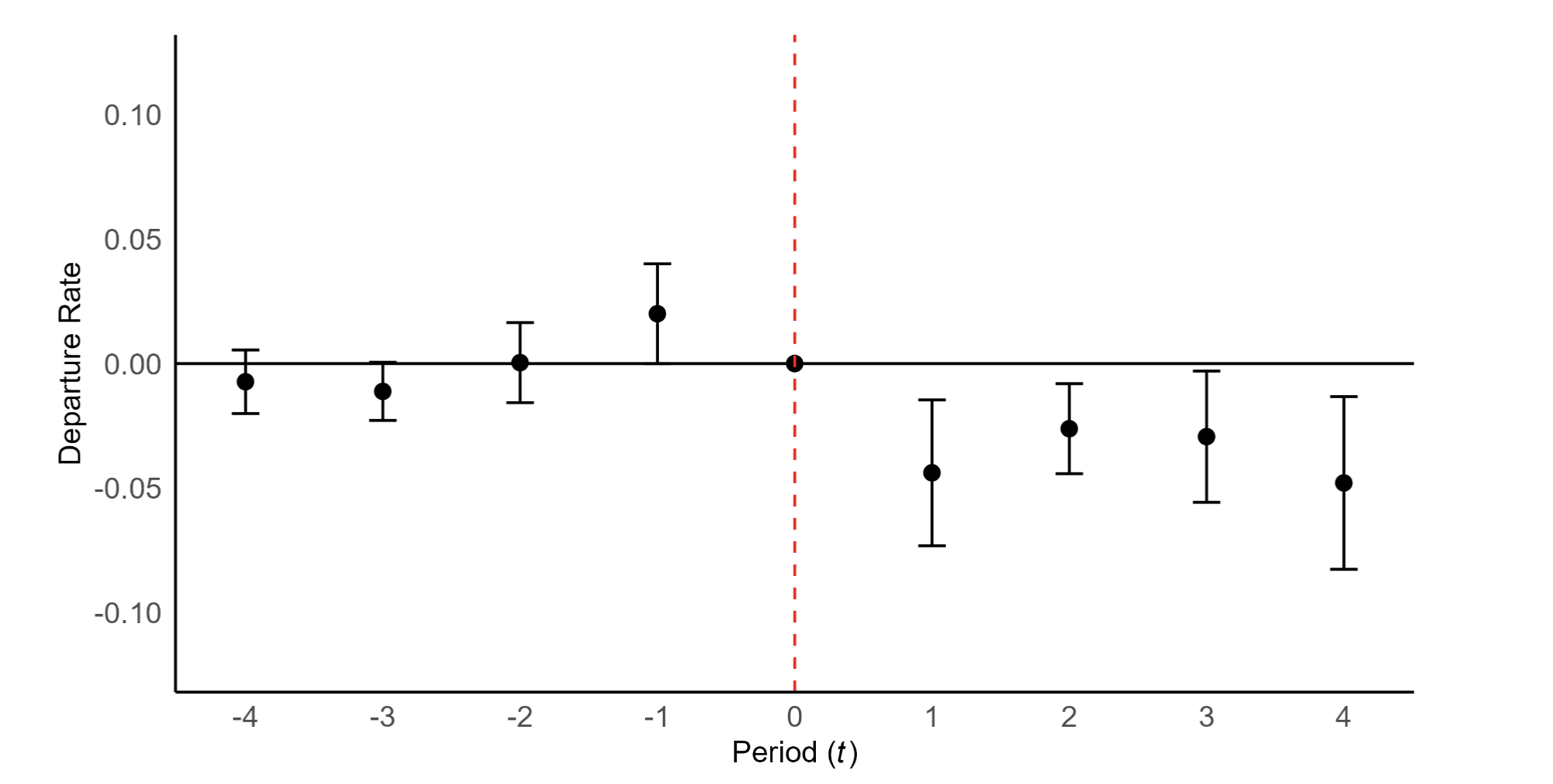
The effect shows up among workers in North Carolina, where the issue was most salient, and it is larger for employees likely to agree with the stance. It is also larger in firms with lower baseline pro-transgender sentiment, where the letter changed more people’s sense of alignment, and among the youngest third of workers, for whom a politically motivated career move is cheapest. But stance-taking may improve retention while deepening political segregation across workplaces (though work in the previous post by Frake et al. shows that corporate segregation while large hasn’t changed that much over time).
Paying for (Dis)Agreement
The research I just synthesised points to a fairly clear trend – companies speaking out has limited backlash and usually works in keeping talent, but the key to success is that alignment between the top and the middle. By contrast, Tahoun et al. (2023) study executives whose politics differ from their employer’s, whom they call “biased” - their term for anyone whose beliefs don’t match the rest of the firm. They measure executives’ beliefs by their private donations and the firm’s views by its PAC donations.
They cover executives at S&P 1500 firms from ExecuComp between 1992 and 2018, matched to 398,035 donations that the authors collected from the FEC. An executive-year counts as Democratic (Republican) if more than half of their two-party giving goes to that party, and executives who give only to their firm’s PAC count as aligned. Of 69,035 executive-years, 41.90% are classified Republican and 23.78% Democratic.
Firms could be hiring these people by mistake, but the pay says otherwise. Biased executives show up in more than 30% of the sample (though 65% of firm-years have none) and get steeper pay-for-performance contracts, by about 26 incentive-intensity points compared with colleagues in the same firm and about 51 within an industry. In dollars, a 1% move in the stock price changes a biased executive’s pay by $26,000 to $51,000 more than an aligned executive’s. The firm is paying for dissent.
The authors test four reasons a firm might want that "bias", and each garners some support. (1) When firms are dealing with low contractability issues, they are 30.9 percentage points more likely to hire biased executives. (2) Firms with prior internal-control weaknesses are 42.6 points more likely, on the logic that executives who see the world differently are less likely to collude. (3) Firms with high R&D intensity, which need more experimentation and information, are 17.6 points more likely, while (4) firms facing high political risk are 15.8 points more likely, perhaps because such executives open doors to policymakers who aren’t natural allies.
Remarkably, around 25% of biased executives who switch firms keep donating to the same party at the new firm, and those who stay biased last about 1.43 years longer, more so at firms with a need for them.
At the top, then, disagreement is a tool and firms pay a premium for it. Further down, Lyttelton and Wilmers (2026) find partisanship pushes in the other direction - managers pay co-partisans more. The setup is political realignment among the people who set pay. As educated professionals have moved left, the party of unions and minimum wages has become the party of managers.
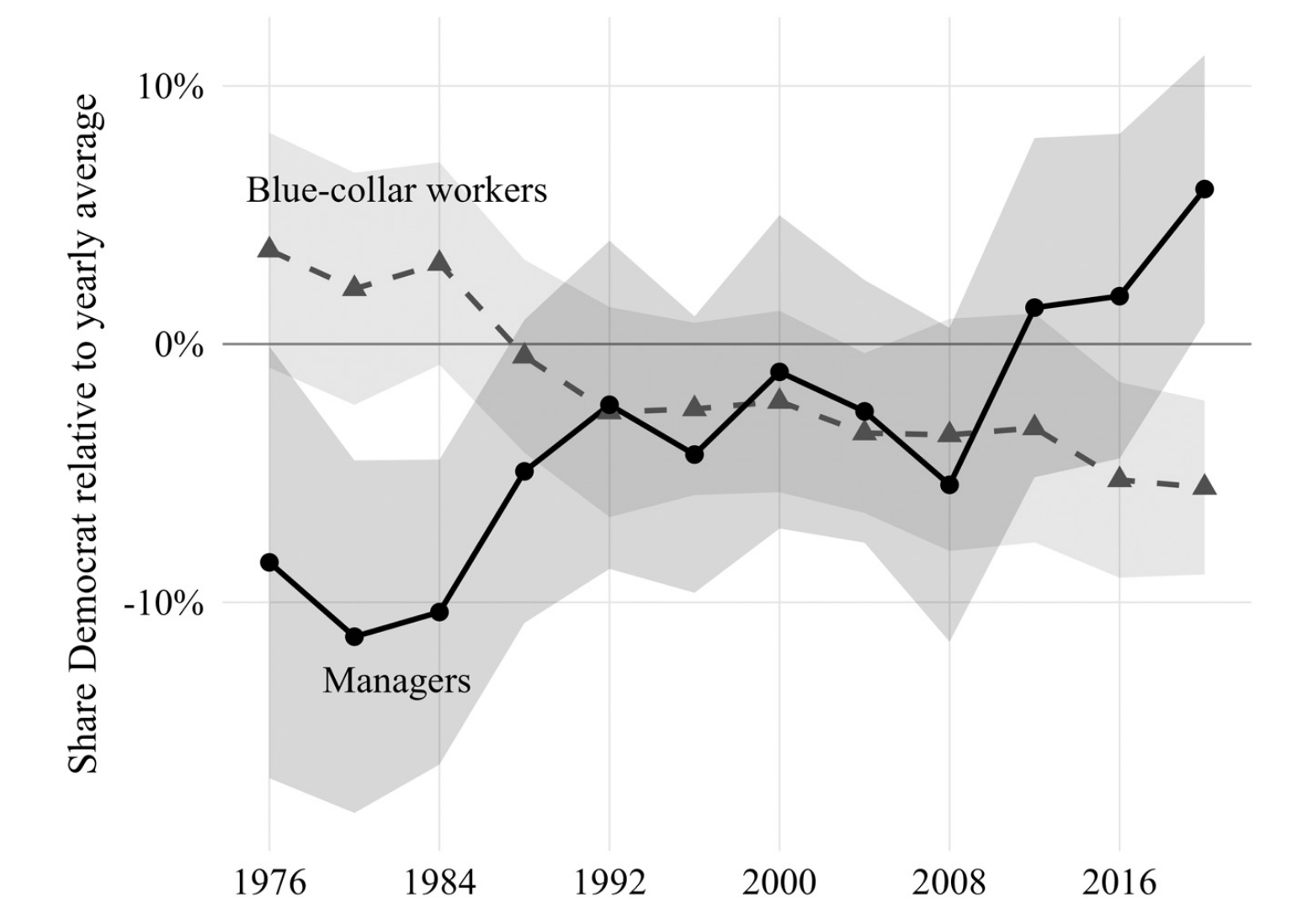
Using General Social Survey data (N = 13,443), the figure shows the crossover. Managers were about 10 percentage points more Republican than the average voter in the 1970s and are now about 6 points more Democratic, with all the realignment happening in two windows, 1984 to 1992 and since 2012. Blue-collar workers moved the other way, toward the Republicans. On redistribution, Democrats’ views have hardened, with agreement that the government should reduce income differences rising from 67% in 2000 to 92% in 2020.
The authors build a dataset of 707,000 managers at 52,000 firms and 3,575,000 hourly wage reports from 2013 to 2022. Managers’ LinkedIn profiles are matched to voter registration (a unique match for 48%), and pay comes from Glassdoor reports. The measure of manager partisanship is the share of a firm’s managers registered as Democrats.
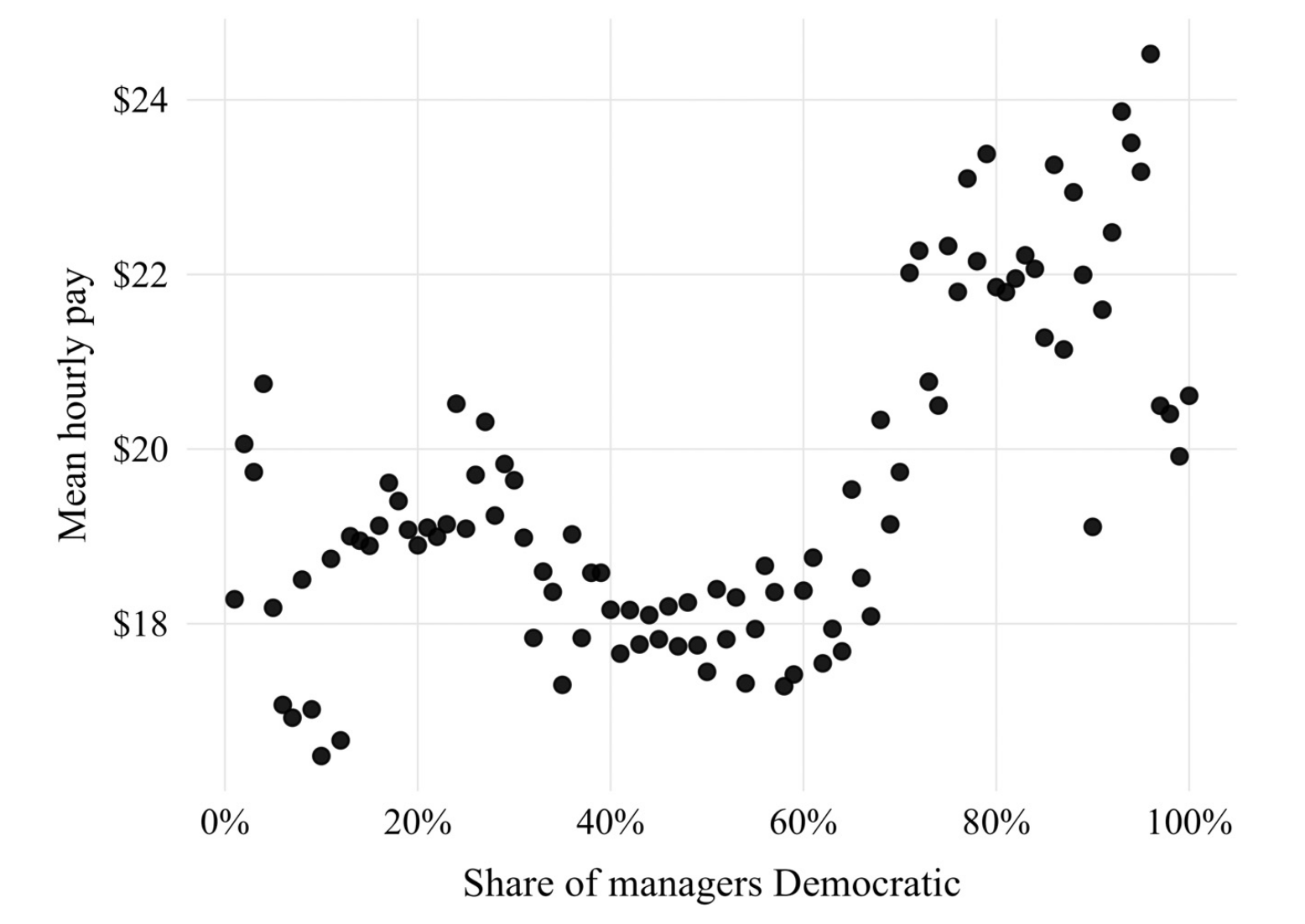
The raw plot tells the story. Firms where more than 70% of managers are Democrats pay about $22 an hour against $19 for the sample overall, a premium of roughly 15% before any controls. That could simply reflect where such firms are, so the authors compare pay within metro-by-occupation-by-industry-by-year cells and the premium survives. Workers in similar jobs in the same metro areas at similar employers are paid more under Democratic managers. With only year fixed effects, a firm with all-Democratic managers pays 6 log points more than one with all-Republican managers, and a one-standard-deviation increase in the Democratic share (0.14) is associated with 0.7 log points.
Not all workers benefit equally. The premium holds only in the bottom half of the earnings distribution and comes only from senior and HR managers, the people who set wages, not front-line supervisors.
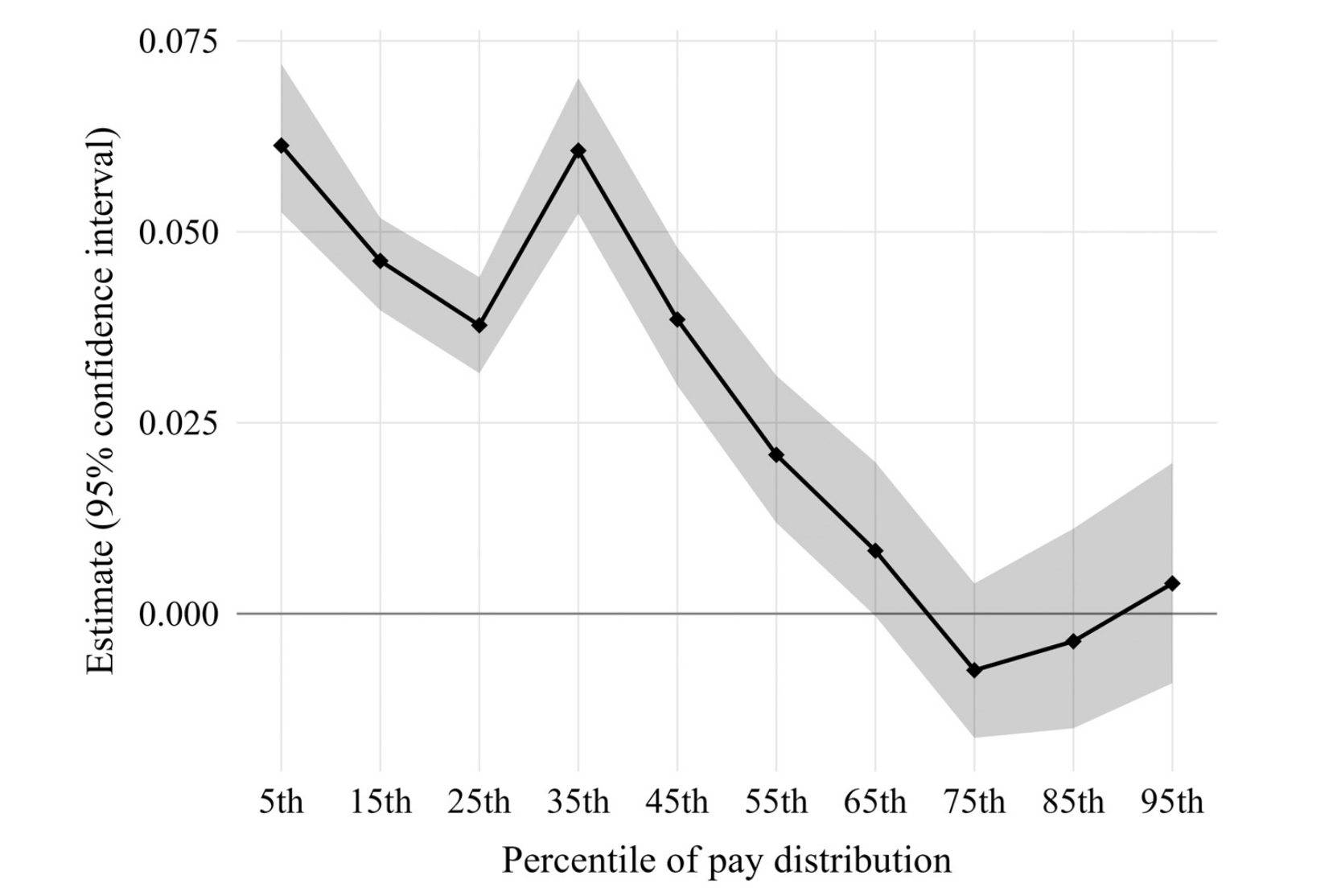
The figure uses an unconditional quantile regression, with the effect estimated at each decile and standard errors bootstrapped 1,000 times. The Democratic premium is strongest for the lowest-paid third and declines to zero by the 70th percentile. Democratic managers aren’t simply more generous. They raise pay most for those they see as needing more help.
The authors argue it’s the activation of partisan identity and not simply a story of values. Managers rarely know workers’ politics, so the favouritism has to run on cues. Democratic managers become relatively more likely to pay $15 wages specifically, in the era of the "Fight for $15," and the premium is larger in Democrat-leaning service jobs, where the cues about gender and occupation point to Democratic workers. In a survey experiment, managers evaluated hypothetical new hires with randomly assigned partisanship and allocated them to high- or low-wage positions. Managers were then 10 percentage points more likely to assign co-partisans the higher wage. To rule out reverse causation (Democrats sorting into generous firms), they regress the average hourly pay at the firms managers move to on their partisanship before the move, and find a relationship close to zero.
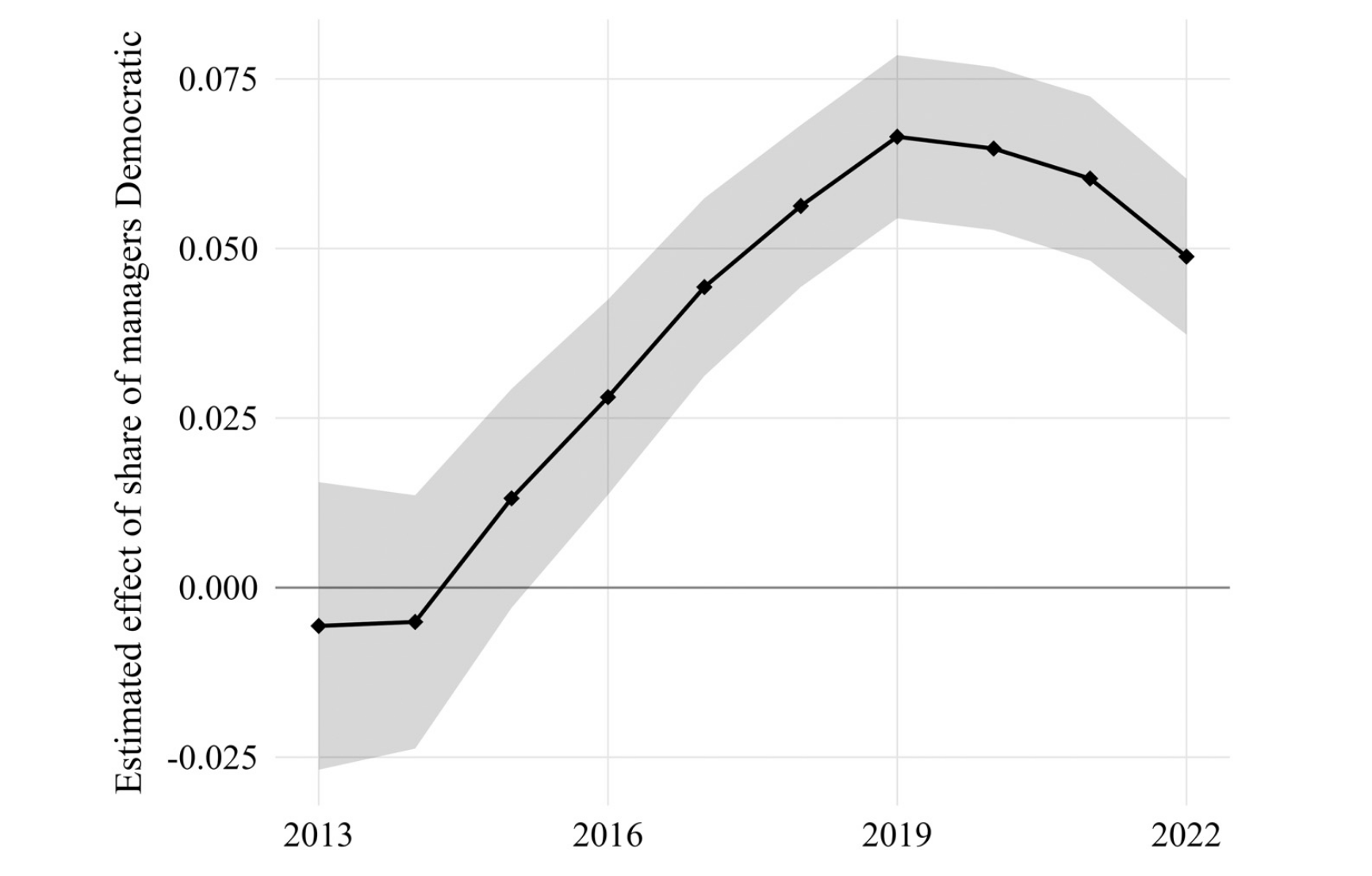
The premium also grows. It rises from 0.5 log points in 2013 to a peak of 7 in 2019 and 6 in 2022, which the authors tie to affective polarization making partisanship more salient and Democrats more committed to redistribution. Dropping managers who first appear in the data after 2013, to rule out measurement error, gives similar results. Combined with the realignment of managers, the premium accounts for 12% of the extra wage growth for low-wage workers over this period.
At the top, firms pay a premium for executives who disagree, because they’re useful for monitoring, information and political risk. Further down, democratic managers pay a premium to workers - an effect that is subject to where an individual sits in the wage distribution and the salience of minimum-wage battles. Executive dissent is paid for deliberately, while the co-partisan wage premium shows up without anyone deciding it. In my last post, the workplace was the one social space that survived polarization intact. It looks like it’s also a place where partisanship pays dividends.