The Costs of Political Connections
Guanxi, Wasta, Krysha - every culture has a term for "influence," for political connections. And this is hardly a "developing world" phenomenon. Trump has turned large parts of the American state in a pay-to-play system, but recent empirical work shows that the depths of connections have expanded across the board, and long before a billionaire took hold of the hegemon. The table below comes from work by Tony He (2025) who built a dataset of 6,522 listed firms across 28 European countries from 2011 to 2017. He matched 106,115 managers and board members against a screening database of politically exposed persons (PEPs), and finds that 7.7% of them were PEPs at some point.
| Number of firms with available data | Number of politically connected firms between 2011 and 2017 | Number of firms connected via a top officer who is/was a government member | Number of firms connected via a top officer who is/was a relative of a government member | Number of firms with a top officer who gained a connection at least 1 year after joining (shock connection) | |
|---|---|---|---|---|---|
| UK | 1140 | 830 | 790 | 477 | 235 |
| Sweden | 767 | 535 | 524 | 266 | 123 |
| Poland | 710 | 396 | 368 | 96 | 68 |
| France | 674 | 361 | 354 | 101 | 86 |
| Germany | 615 | 304 | 292 | 63 | 52 |
| Romania | 356 | 136 | 121 | 40 | 33 |
| Italy | 293 | 190 | 184 | 81 | 23 |
| Spain | 217 | 157 | 153 | 62 | 43 |
| Switzerland | 198 | 134 | 130 | 51 | 42 |
| Greece | 191 | 63 | 63 | 11 | 5 |
| All countries (28) | 6522 | 3885 | 3710 | 1591 | 925 |
Note: Shows the 10 countries with the most firms with available data; the final row covers all 28 countries in the sample, not just these 10. The number of firms with available data is the number of public companies found in the BvD Orbis database with headquarters located in the specified country that were publicly listed on any stock exchange between 2011 and 2017. A firm is politically connected if at least one top manager or a board member is classified as a PEP in the RDC database between 2011 and 2017.
At the firm level, 59.6% of the firms had at least one connected insider. These numbers are remarkable. One of the landmark studies on the benefits of politician connections - Faccio (2006) - put the UK at 7.2% of listed firms with connections late 1990s. He finds 72.8%. Some of that increase is surely attributable to just better data and measurement but I, and the author, are skeptical it can explain a 10-fold increase on its own.
There is a massive academic literature fortifying the folk wisdom that these connections pay - Tony He looks at “non-hired” connections as an identification strategy. Using when an executive becomes a PEP after joining, because say a relative wins office. These connections raise the annual value of public contracts won by about 26%. While ties to top level elected officials are lucrative, the action is in the middle-tier. Link middle-tiers to staffers, to aides, come to a 42% increase in state-contract value.
Even if we expect politicians to pander, they have limits and the spotlight often diminishes their value. The paper is useful not just as an illustration of the depth of connections, but that we need to think more systematically about the downsides of connectivity.
Scholars have fortunately begun to examine when political ties blow back. Just because you have a line to a politician doesn't mean you're insulated - phones go both ways. What happens when you're in a system where multiple regulators might be able to come after you? Especially when the regulators have their own political battles. And who wants to be in a joint-venture when you know your nominal partner has the political power to expropriate you?
The Reciprocity of the Favour Economy
As you'll see through this review, there are several ways to conceptualise and measure "political connections." The most blatant way a firm can be connected to a government is through ownership - when the state is a majority shareholder. The propensity for government's to interfere with their companies economic operations was one of the main reasons we saw wave after wave of privatizations in the '90s and 2000s.
SOEs can certainly serve as political playthings. But I've been heavily influenced by the work of Rawi Abdelal who shows that even the most geopolitically fraught of companies - in his research Gazprom - mostly work like normal firms. But there are specific moments where they need to turn into tools.
India is one place where the state continued to play a major role in the economy through the neoliberal era, and recent evidence indicates that its been subject to some of the worst tendencies. Alok and Ayyagari (2020) use the country’s constitutionally fixed election calendar to track 18,981 investment projects announced between 1995 and 2009. In election years, state-owned enterprises announce 17% more projects (central SOEs) and 27.5% more (state SOEs) in a district, tilted toward visible infrastructure like construction and community development.
The effect is particularly concentrated in arenas of high political competitions. When elections are close , state SOE investment jumps by 51% compared to uncompetitive districts. Private firms show no such pattern. Each extra project is associated with a 0.9% increase in the incumbent party’s margin of victory.
Again this isn't a "developing world" phenomenon. Li et al. (2020) examine more than 140,000 SOEs across 25 European countries and just over 80 national elections between 2001 and 2015. SOE investment rises by about 29% of the sample mean in election years, while matched private firms cut theirs by about 31%. The latter makes sense because firms are meant to diminish their investments when the environment is uncertain, like with an upcoming election. The SOE increase is strongest where checks on executive power are weak and where the state controls the banking system, which lends more to SOEs when an election looms.
The promise of new projects is new jobs. SOEs could also just hire more people to get them on the incumbents side, and that's what they appear to do. Employee growth at SOEs is 169% higher in election years. That number needs a caveat, since mean employee growth in their sample is close to zero, so it’s a big percentage of not very much. But the direction is the point.
Some of this might be unsurprising given the state has reins over the nominally corporate balance sheet. The more interesting finding would be if firms feel compelled to employ more people when their political connection is up for re-election. Bertrand et al. (2018) find as much in France. They define a CEO as connected if they previously served as a close advisor to a top government official, a common route to the corporate suite in statist France. These are the staffers from He’s results, a few years on post-revolving door. In the 1990s, former civil servants controlled 11% of listed firms, representing 63% of listed assets.
Analysing publicly traded firms from 1987 to 2002 alongside municipal election results in the 900 largest cities, the authors find their firms are more likely to hire and less likely to fire in the run-up to local elections, and they open more plants and close fewer. Again, the effect is strongest in contested races, where jobs matter most to the incumbent. The payoff is slightly larger for mayors who previously served as national ministers. What I find most interesting is that the authors find only weak evidence that shared party affiliation matters - it's about keeping incumbents who might have made previous deals with an exec on the political board.
If this were the start of a trade, the firm should be paid back. But connected firms don’t receive higher subsidies or lower local taxes, even though local politicians control both. And when a firm hires a connected CEO, return on assets and profits go down, while replacing one unconnected CEO with another changes nothing.
Duelling Mandates
So far we've been discussing the links a firm has to a single specific individual and their political capital. But states aren’t unitary actors - there are national and local officials, bureaucrats deciding contracts, lawyers deciding prosecutions. Few systems are as comlpex as China. Its administrative system has five levels with political representation (national, provincial, prefectural, county and township), and each has its own agenda that a firm might get "bound" to.
"Binding" is instances where firms are forced to align with a political actor’s agenda. Continued support is conditional on following the bureaucrat dictated script. The question is what happens when multiple government actors could bind a firm, and when those potential binding agents disagree.
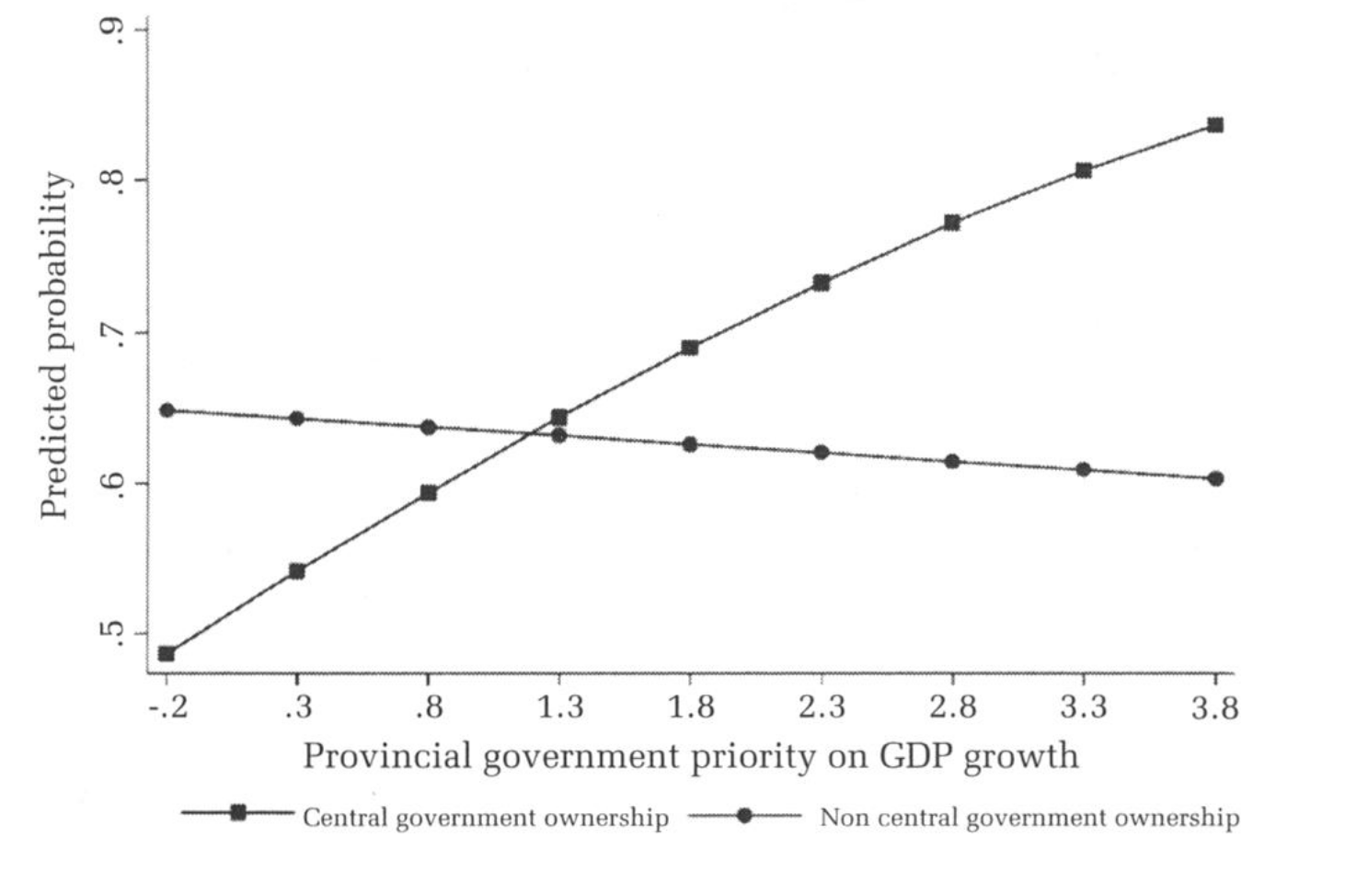
The trade-off becomes clear with the standard growth vs. emissions trade that China has been forced to grapple with. When the Chinese central government agencies issued guidelines on corporate social responsibility (CSR) reporting, many provincial governments kept prioritising short-term GDP growth. That put the centre and the provinces at odds, leaving firms having to navigate the potential contradictions.
Luo et al. examine publicly listed Chinese firms from 2008 to 2011 - when those national CSR mandates came down. They assess links to the top by looking at central government ownership or C-Suite links a to the National People’s Congress (NPC) or the national political advisory body (CPPCC). Those firms responded with early adoption but low-quality reports. The authors call it decoupling. Sign up first to satisfy Beijing, then implement badly to avoid annoying the province.
Being connected didn’t protect these firms from conflicting demands. It made them potential targets of both.
Li et al. (2026) take the same logic and directly apply it to pollution (rather than broader CSR-logics). The result is that the same kind of tie pushes in opposite directions depending on which level of government it connects to. The authors use 6,758 observations of fully privately owned Chinese firms from the National Survey of Chinese Privately Owned Enterprises (waves from 2008 to 2014), excluding any state ownership so that the ties aren’t a stand-in for the state owning the firm. 38.64% of the observations had either a low-level or a high-level achieved tie.
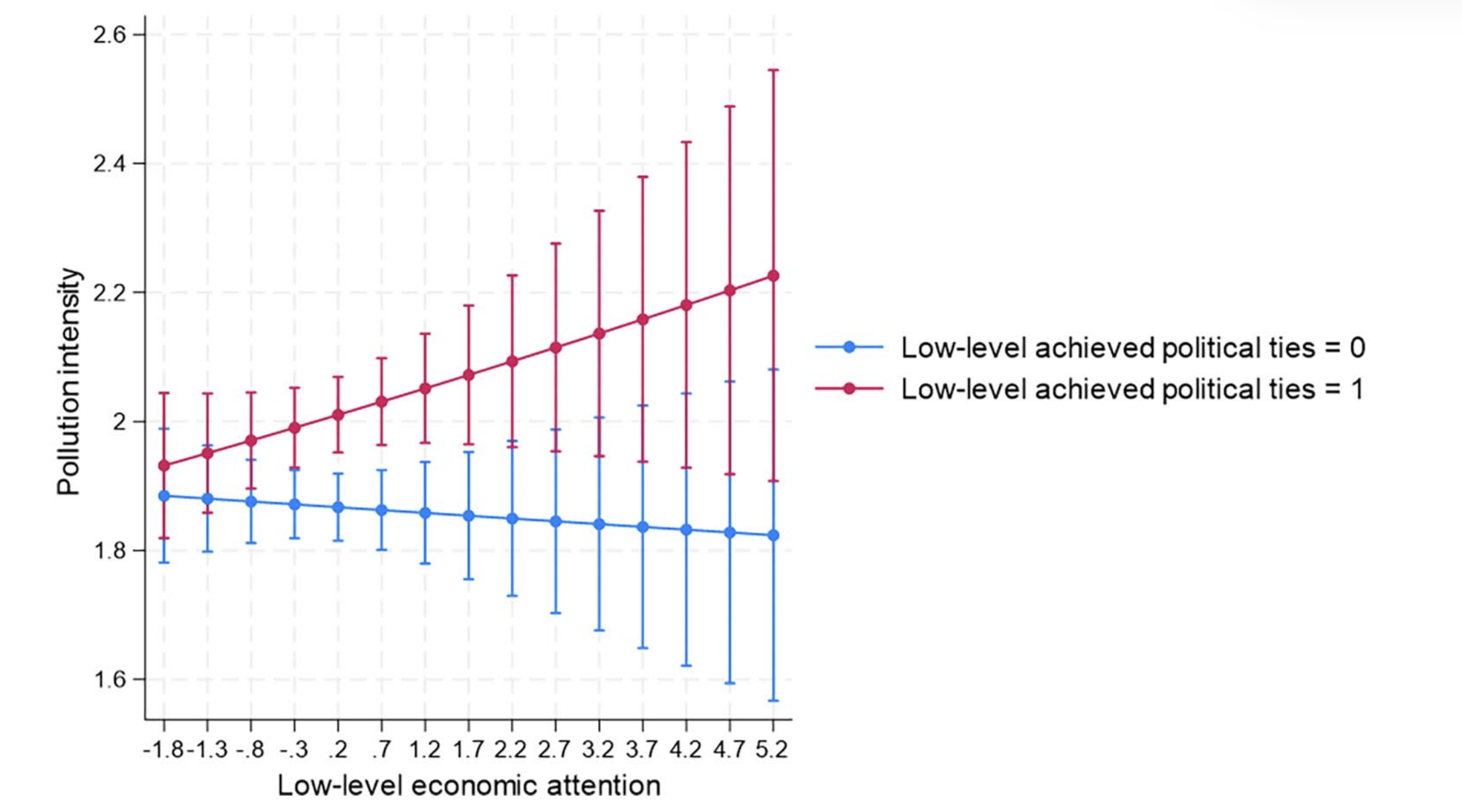
Pollution is proxied by the levies firms pay, which the authors validate against a composite emissions index for 12,952 industrial firms in 2014. Firms with achieved ties to the provincial or national government pollute less than firms with no ties. Firms with achieved ties at the prefectural, county or township level pollute more. The explanation is the one from Luo. High-level governments care about the environment and have the power to enforce it, while local governments are incentivized to care about growth and tolerate the emissions that come with it.
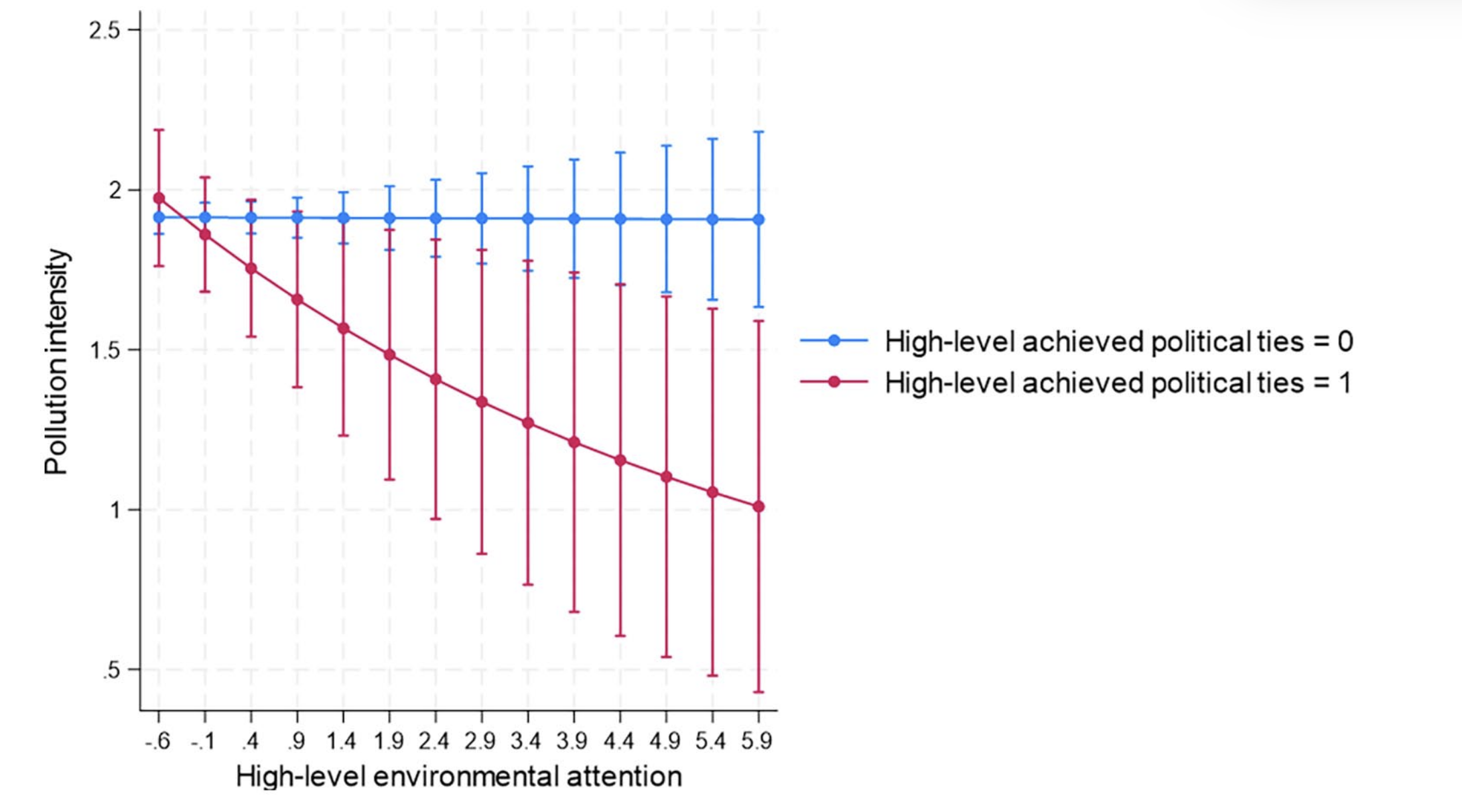
The binding also varies with who is being bound. When a high-level government is paying close attention to environmental goals, its ties bite harder (firms are forced to emit less, see above). The authors further introduce a class dimension: firm owners of higher social class are bound more tightly by high-level ties because they face greater moral pressure and a sense of duty. By contrast, when your tie is local, and the pressure is on the provicne to boost growth, the firm becomes more likely to emit (see below).
If binding is one possible effect of a tie, the opposite is buffering, where the tie shields you from what the government wants. Zhang et al. (2016) ask whether charitable donations get bind or buffer. In China, the government tightly restricts independent NGOs, so charities are mostly government-organised. A donation isn’t a purely voluntary act of generosity, since it’s often a response to pressure. Among donating firms, the average gift is about ¥1.3 million (roughly US$175,000), or 1.7% of profits and 5.2% of cash flow.
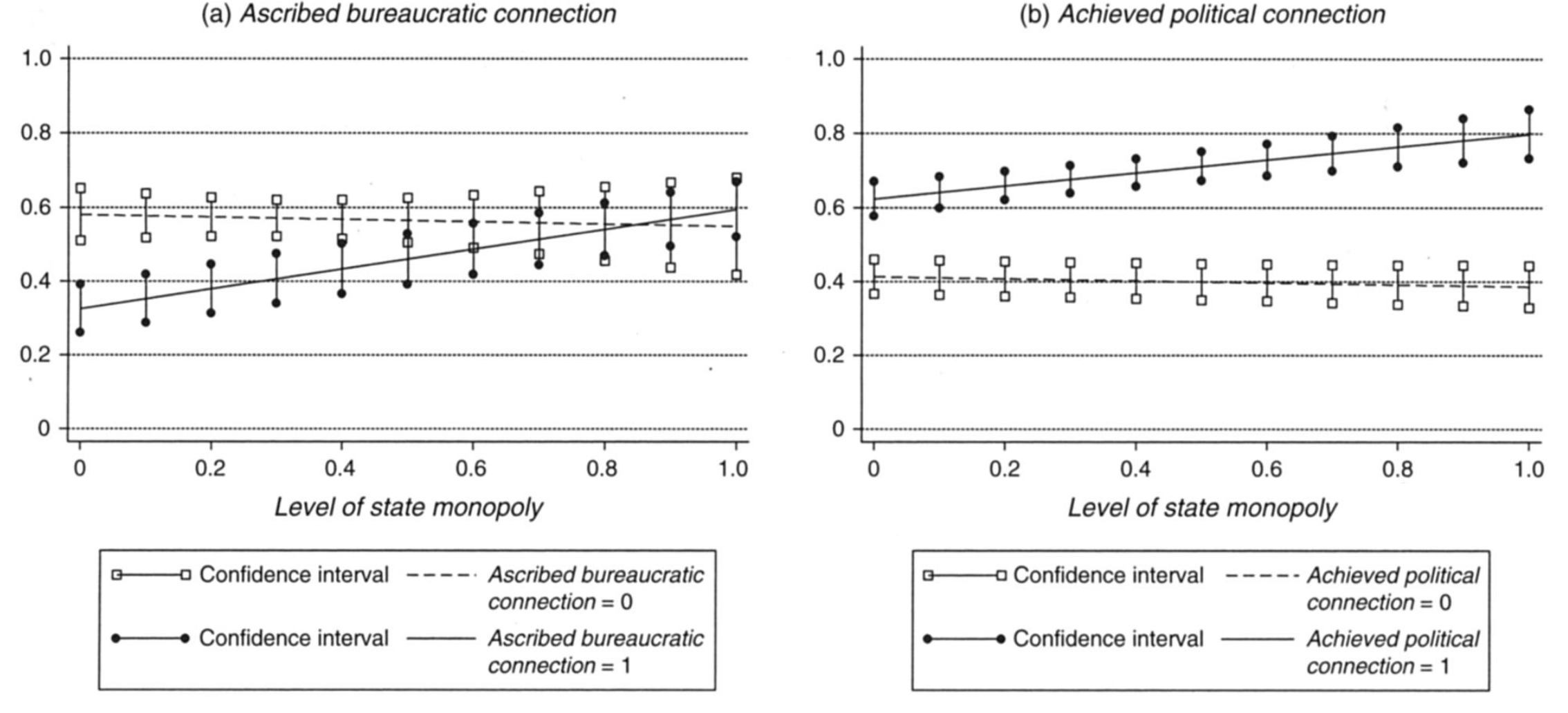
The authors follow 820 privately controlled listed firms from 2001 to 2012 (5,803 firm-years) and distinguish two kinds of ties. Ascribed ties are an executive’s prior government work experience, a background characteristic from before they entered business. Achieved ties are prestigious appointments, such as seats in people’s congresses or political councils, which result from the executive’s or the firm’s own success.
| Ascribed bureaucratic connections | Achieved political connections | |
|---|---|---|
| Definition | Based on actors’ background characteristics | Reflecting or a result of actors’ current position |
| Expression in China | Former government officials before taking current position | Appointment to political body or council after achieving current position |
| Tie cultivation mechanisms | Deep political embeddedness; political insiders now working outside the government | Result of CPA, transaction/exchange between business and government; political outsiders now with a position inside the government |
| Functions | Knowledge, skill, network | Political recognition, network, responsibility |
| Pressures | Detaching effect; no government/social expectation | Attaching effect; expected to shoulder obligations and duties |
| Outcome | Buffering | Binding, co-optation |
The two types of connections have stark consequences. Executives with ascribed ties - pre-existing political capital - are more likely to use them to buffer the firm from donation pressure, while achieved ties tend to bind firms into donating. A former bureaucrat knows the system and has friends in it. They've shown prior loyalty and can say no. An appointee has been co-opted, and a seat at the table can be withdrawn.
But the effects depend on how much the firm needs the state. In state-monopolised industries, where firms depend on the government for licences and favourable treatment, buffering weakens and binding strengthens. In competitive industries and less market-oriented regions, ascribed ties buffer more. Regional context can even flip the sign: in less market-oriented regions, achieved ties buffer firms too.
“Being connected” may not be the right unit of analysis. A tie is a relationship with a particular office, at a particular level, with its own agenda and its own leverage. And in a system with multiple layers, the phones ring at the same time. This is also a problem for outsiders trying to value a firm. If a tie can protect you, bind you or both, depending on who’s on the other end of it, then what exactly are investors pricing?
Market Responses
A lot of our understanding of the value of political connections comes from stock market "event studies" - Fisman (2001) famously used rumours surrounding Suharto's death as an exogenous (perceived) loss of connections and then studied how firms linked to the regime abnormally traded after the news. A host of new work is now using similar methods to assess the conditions under which markets raise concerns about potential cronyism.
Let's go back to the Indian SOEs that announce more projects in election years. Those firms are partially privatized, so they have public shareholders who can respond. When Alok and Ayyagari look at the stock market’s reaction to project announcements, announcement returns are negative on average, and lower still for projects announced during election years and in politically competitive districts.
The market marks projects down when the political motive is strongest. Set that against the politician’s gain, a 0.9% bump in the incumbent party’s margin of victory, and the trade looks lopsided. The authors’ own conclusion is that politicised investment can hurt a firm’s public shareholders.
But picking up on those favours - that the investments might be politically rather than economically motivated - is straightforward in that context. Election timing is known. Part of the public backlash to corruption often comes from the shady/backdoor nature of it all, and how hard it is to track what's really happening. Fisman and Wang (2015) look at not just how the market responds to potential revelations, but also at the social costs of the connections.
The authors study listed Chinese firms from 2008 to 2013, defining a firm as connected if its CEO or another C-suite executive previously held a high-level government post. Workplace death rates at connected firms are two to three times higher than at unconnected ones, in a country where the overall worker death rate was already over 20 times the UK’s.
The political connections initially have a gain - regulatory forbearance. There were no public reports of a major workplace safety audit at a connected company, versus just under 5% at comparable unconnected firms, and connected firms are fined less often for pollution. In years without fatalities, connected firms also get fewer reports of major safety violations. Connections are further associated with a return on assets (ROA) premium of about 1.7 percentage points in the full sample. The authors are careful to say that skimping on safety is unlikely to be the only reason for the premium.
But the spotlight can break the protection racket with direct economic costs. In years with a fatal accident, the government reported violation rate at connected firms is identical to everyone else’s. Fortunately, the privilege disappears when there’s a body count.
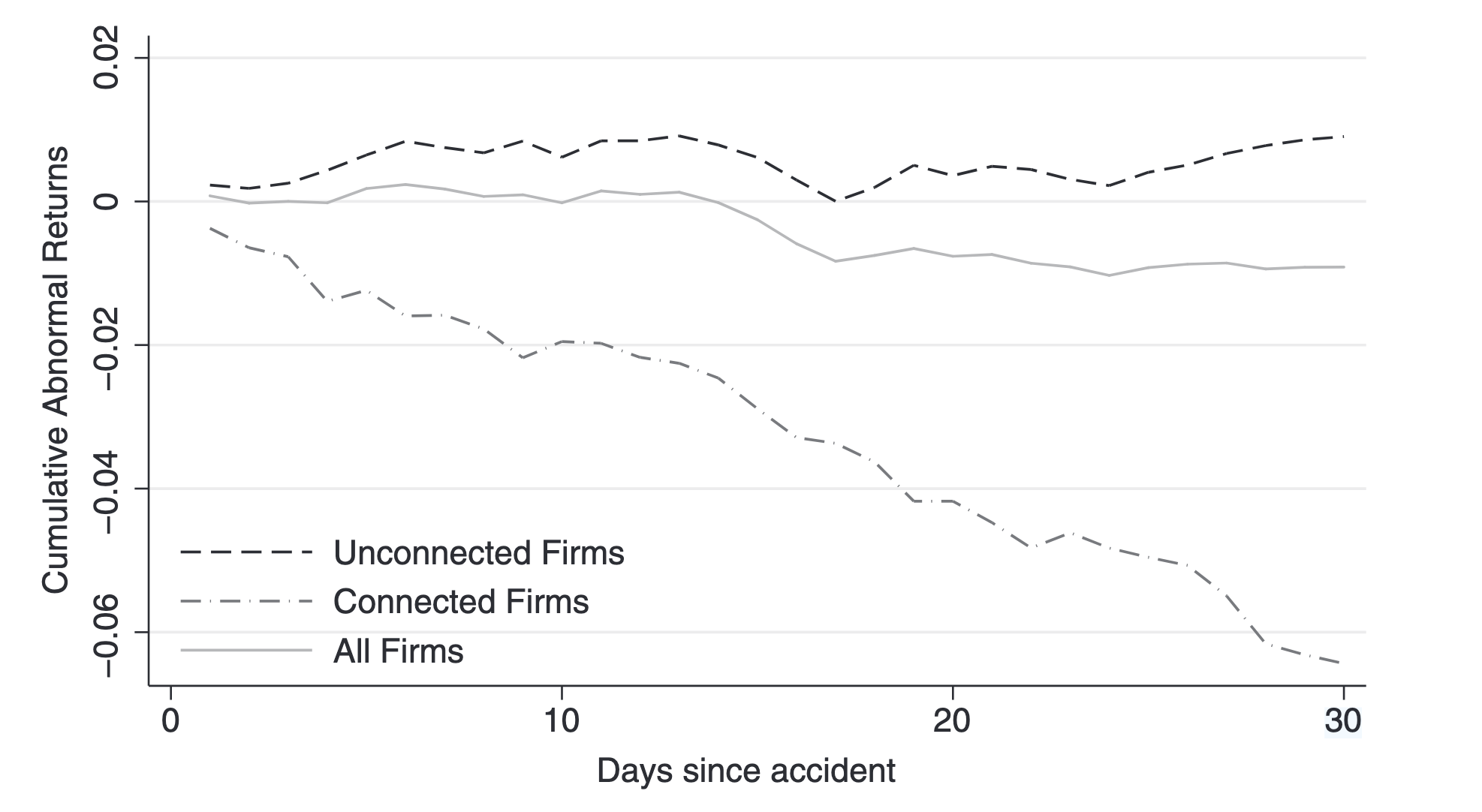
The figure shows what the market does next. Unconnected firms barely move after a fatality report, with average abnormal returns slightly positive but never distinguishable from zero. Connected firms drift down steadily from the date of the accident. Over three days they fall about 1.4% more than unconnected firms, and by more than 8% after 30 trading days.
However, the executives do fare better than the shareholders. In 19 of the 26 cases where a connected executive left after an accident, they moved on to another high-level job elsewhere.
This paper is rich. The authors next exploit the staggered passage of “No safety, no promotion” laws across provinces, which made regulators’ careers depend on meeting safety targets. Death rates fell where those laws passed, primarily at connected firms. That’s a duelling-mandates story in miniature. When the regulator’s own promotion is on the line, a connection to someone else stops serving as a shield.
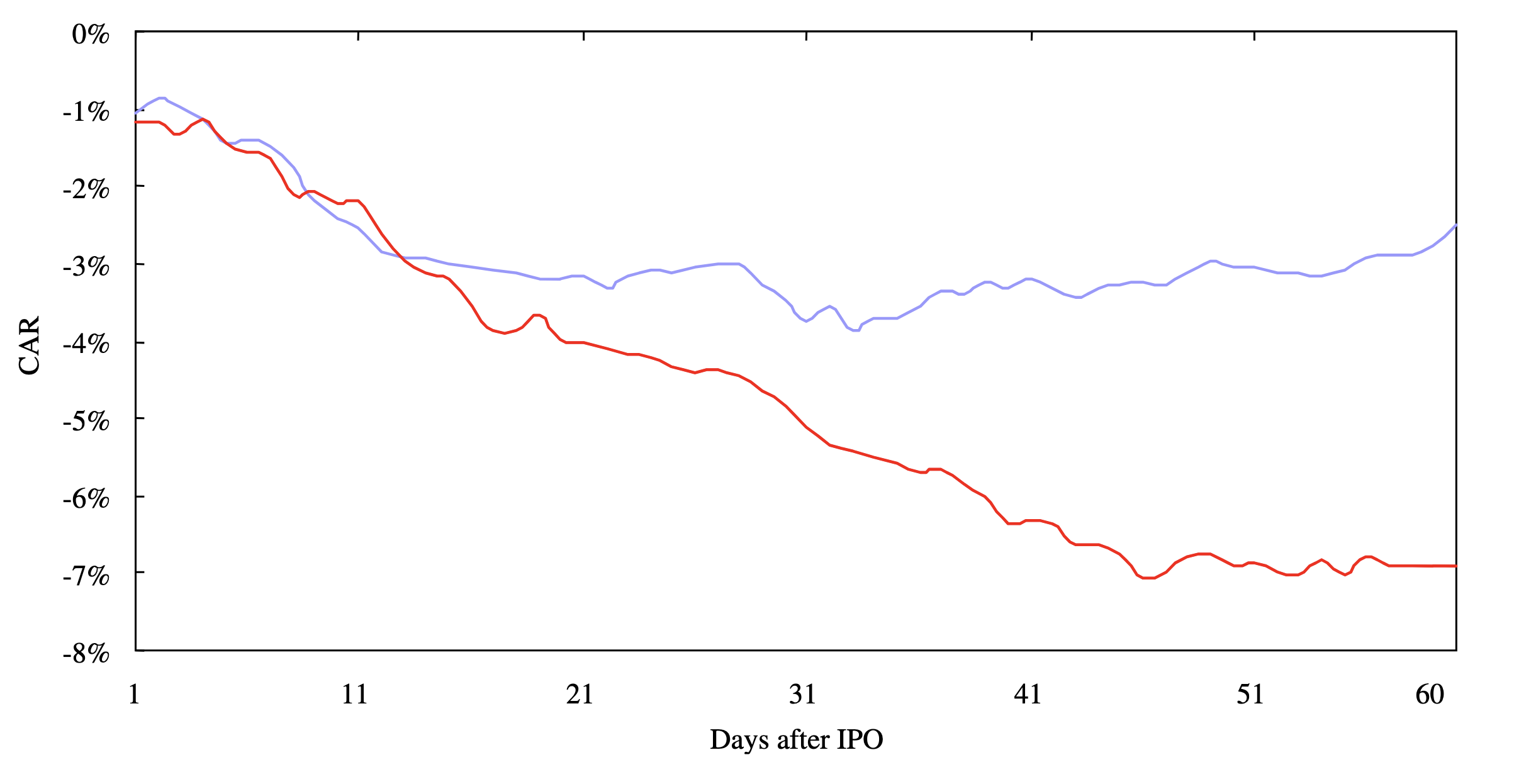
So investors do eventually price the downside, and on occassion they even see it from the get-go. Fan et al. (2007) look at the moment of maximum information asymmetry, the IPO. Their sample is 790 partially privatized Chinese firms that listed between 1993 and 2001. Almost 27% of the CEOs were current or former government bureaucrats. Those firms underperformed by almost 18% over the three years after their IPO, and had weaker earnings growth, sales growth and changes in return on sales. The authors also find that firms led by connected CEOs are more likely to fill the board with other bureaucrats instead of directors with relevant professional backgrounds.
Three years in, connected-CEO firms lose about 30% of their value, while the comparison group suffers a much smaller decline. Fan et al. also plot the first 60 days after listing, which is where the negative first-day effect of connected CEOs shows up (see below).
The penalty isn’t always for your own conduct. Li (2023) argues that a connection secured through the revolving door, meaning a former government or Party official hired as a director or senior executive, signals political capital only while political leaders are secure. When leaders are unexpectedly dismissed, it becomes a liability, and the damage reaches all connected firms, whether or not they were involved in the scandal. The channel is external finance. Lenders and investors who see political risk rising pull back, and banks provided 24.5% fewer loans to firms hiring revolving-door officials than to unconnected firms. The credit squeeze becomes a liquidity problem, which then hits profits. The author’s back-of-the-envelope estimate puts the annual cost at roughly RMB14 million (USD2.2 million) for a firm with average assets. A firm can behave perfectly and still pay for the company it keeps.
Fear the connected
Although we love to obsess over stock prices and market responses, all of that comes second. Companies need customers, and suppliers to thrive. Markets only work when people trust that sellers will deliver and that the courts will back the buyer if they don’t. Political connections can contradict that process. The tie that helps win you contract might make a counterparty wonder which way the judge will lean when you break one.
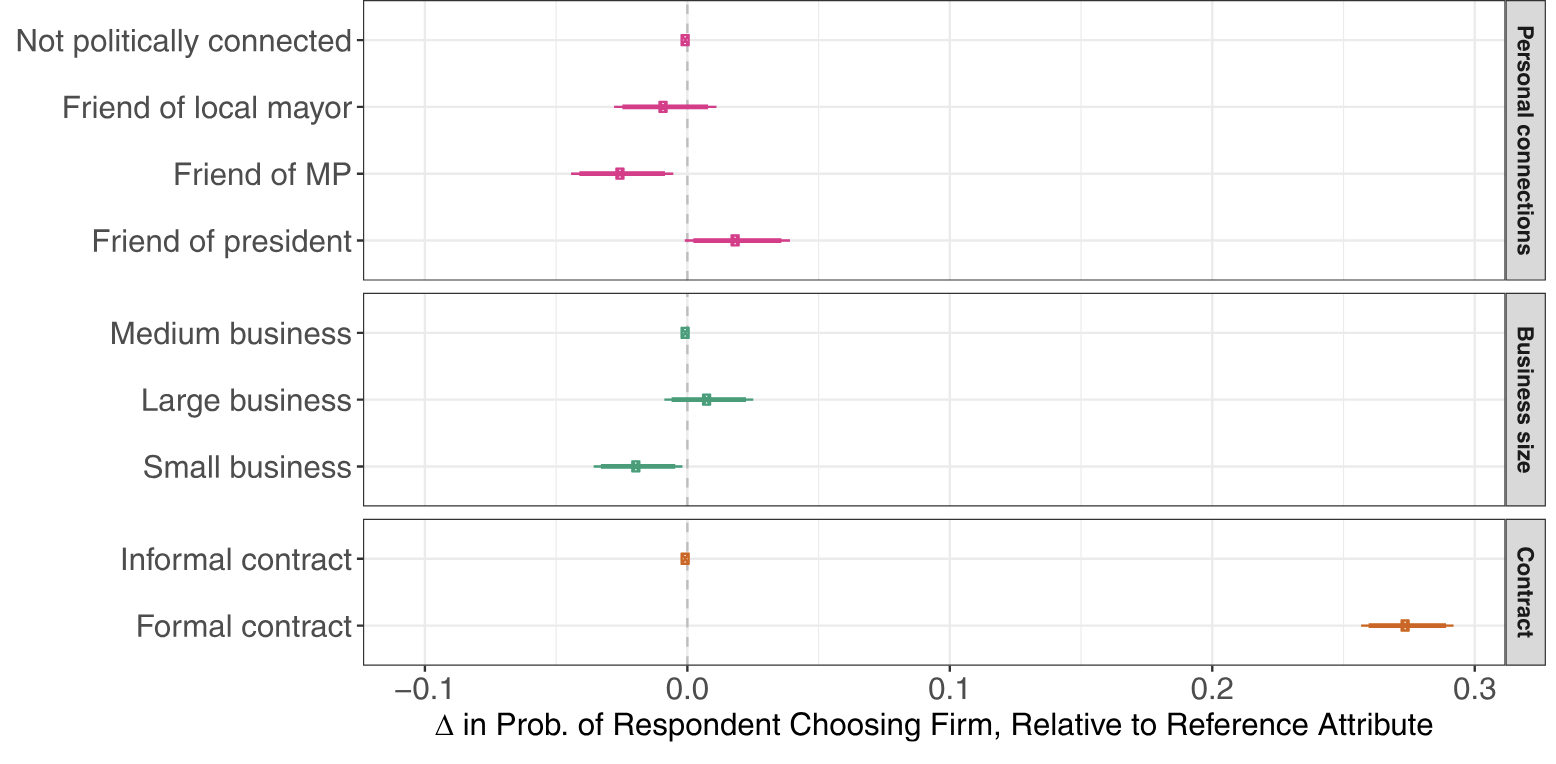
The most inventive test of this comes via Abhit Bhandari (2022) operating in Senegal. He created and legally registered a sales business, then hired employees to sell mobile phone credit to 1,458 households. The experiment randomized two things. First, whether employees signalled political connections, which they did by mentioning during the long introductions customary in Senegal that they had previously worked at one of three influential municipal councils in Dakar. Remarkably, Abhit managed to convince the councils to hire and host the employees beforehand, making the claim credible.
Second, he randomized whether the employees offered a formal contract. Buyers could pay 700 CFA for 1,000 CFA of credit delivered nearly instantly, where the risk was that the bonus credit would be of lower quality than promised. Or they could pay 500 CFA for 1,500 CFA of credit delivered three days later, which added the risk of non-delivery.
Political connections decreased buyers’ willingness to exchange. The author’s argument is that in societies with selective rule of law, buyers believe a connected seller can break a deal with relative impunity. Formal contracts increased trade, especially for the delayed-delivery option. But the contract’s benefits were driven by buyers who were themselves politically connected. The state-backed fix for moral hazard works mostly for people who already have the state’s ear. This tracks with work on who tends to win in Chinese courts.
In follow-up work Bhandari (2023) surveyed 2,389 Senegalese firms - rather than consumers - with respondents who hold real decision-making power over new business opportunities. Each respondent chose between hypothetical deals with randomized attributes, and said which one they were more likely to accept and which was more likely to end in breach. Co-religiosity (but not co-ethnicity) made deals more likely to be accepted, probably because religious brotherhoods create networks where the cost of defecting is high. Written contracts helped too. Again, political connections, whether party affiliation or personal ties to those in power, made firms less likely to exchange.
There was one exception, and it’s the most interesting result. For the most highly connected partners, respondents saw significant risk of breach but sought the deals anyway, because of the potential reward. That’s the standard story from the start of the post, showing up inside the decision of a counterparty. For most connected firms, the risk outweighs the prize. For the very best connected, the prize wins. But we do know from descriptive work that the very top tends to bifurcate along political lines in competitive political spaces.
We see a similar story play out across countries. Kubinec et al. (2024) recruited 3,329 employees, managers and CEOs through Facebook advertisements in Egypt (1,005), Ukraine (1,512) and Venezuela (812), three high-corruption countries with different regimes. They showed respondents fictional companies with randomly generated attributes, from sector and size to country of origin and political connections, and asked which they’d invest in. On the whole, respondents were less likely to choose connected companies, and especially those tied to more influential political figures.
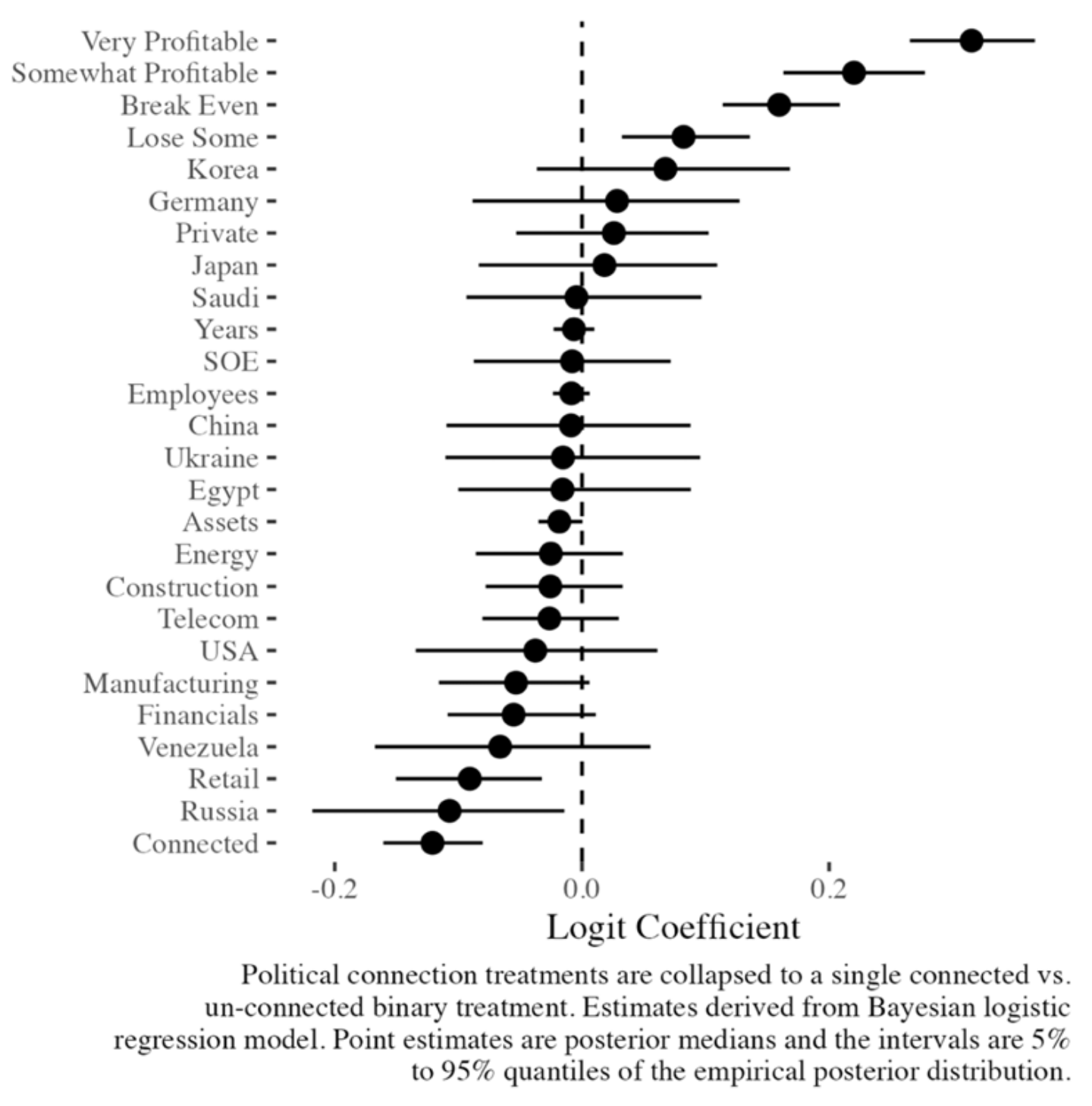
But the average hides a revealing split. Respondents at highly connected companies, particularly those with valuable ties, preferred connected investments, while respondents at unconnected companies preferred unconnected ones.
The authors’ explanation again turns on how disputes get settled. Connected firms are more likely to resolve disagreements informally rather than through courts or law enforcement, and may behave more opportunistically if their ties shield them from punishment. So for an unconnected investor, a connected firm may protect you from predation by officials but create a new risk of predation by your business partner. Connected firms may be able to handle that. Everyone else would rather not.
Put these papers together and connections look less like a tax on one firm and more like a fault line through the market. In Bhandari’s experiment, contracts protect connected buyers best. In Kubinec et al., connected insiders prefer connected investments, and unconnected ones keep their distance. Trade sorts itself along political lines, and the pool of counterparties willing to deal with any one firm shrinks. No single firm is punished, but the market ends up thinner and more unequal.
Unanswered Calls
None of this means connections don’t pay. It does suggest the relationship goes both ways where the payoff is often a function of features firms don't control.
A connection pays while your patron is secure and you answer to only one. It stops paying when the favours you owe outweigh the ones you collect, as with Bertrand’s CEOs and the Indian SOEs. It stops when a second office with a different agenda picks up the phone, as in Luo, Li and Zhang. It stops when what you were shielded from becomes visible, as in Fisman and Wang. And it stops when lenders, counterparties and investors decide you’re a risk because of your power, as in Bhandari, Kubinec and Li (2023). Visibility is the thread running through all of it. He (2026) found that the most valuable ties are the least visible ones, and the costs mostly arrive when the tie stops being invisible.
The question for any firm with a number to call is who else has its number, and what they’ll ask for.