Politics at Work: What does Corporate America Think?
One of the standard tropes of political discourse is that the left is for labour and the right is home of the corporate elite. We know that narrative has been breaking, but the way we usually understand it is via a migration of the working class, of globalization’s forgotten, shifting to the likes of the GOP and the AfD. For a brief moment in the 2010s, as notions of “woke capitalism” pervaded our discourse, we began to see a potential crossing at the top as well. Those debates stopped once the broligarchs showed up.
In this post, I want to return to the corporate movement and the preferences of the business elite, because their dollars do matter in elections and – even if their most vocal members are ready to cozy up to whoever is in power - their views are less untethered but still shifting.
The view from the top
To understand what corporate America wants, Reilly Steel (2024) used revealed preferences. He built a dataset of 97,469 directors and executives at 9,005 US companies from 2001 to 2022 by merging BoardEx (employment histories) with the DIME database (campaign contributions that get converted into an ideology score). The matching is done through a multi-step machine-learning procedure, exact name-and-employer matches first, while race and ethnicity are predicted with an ensemble of GPT-4o and a neural network trained on voter registration data.
Steel finds that average observed ideology among directors and executives moved from modestly conservative in 2001 to roughly centrist by 2022, a shift of about 42% of a standard deviation. This wasn’t people changing their minds – we rarely do. The result is mostly a function of turnover- or what we might call a “cohort” effect - where people who grow up more liberal stay more liberal.
That nets out to a different picture of Corporate America than our basic mental model. Less red and more purple, turning it away from a conservative stronghold to a large potential set of swing players.
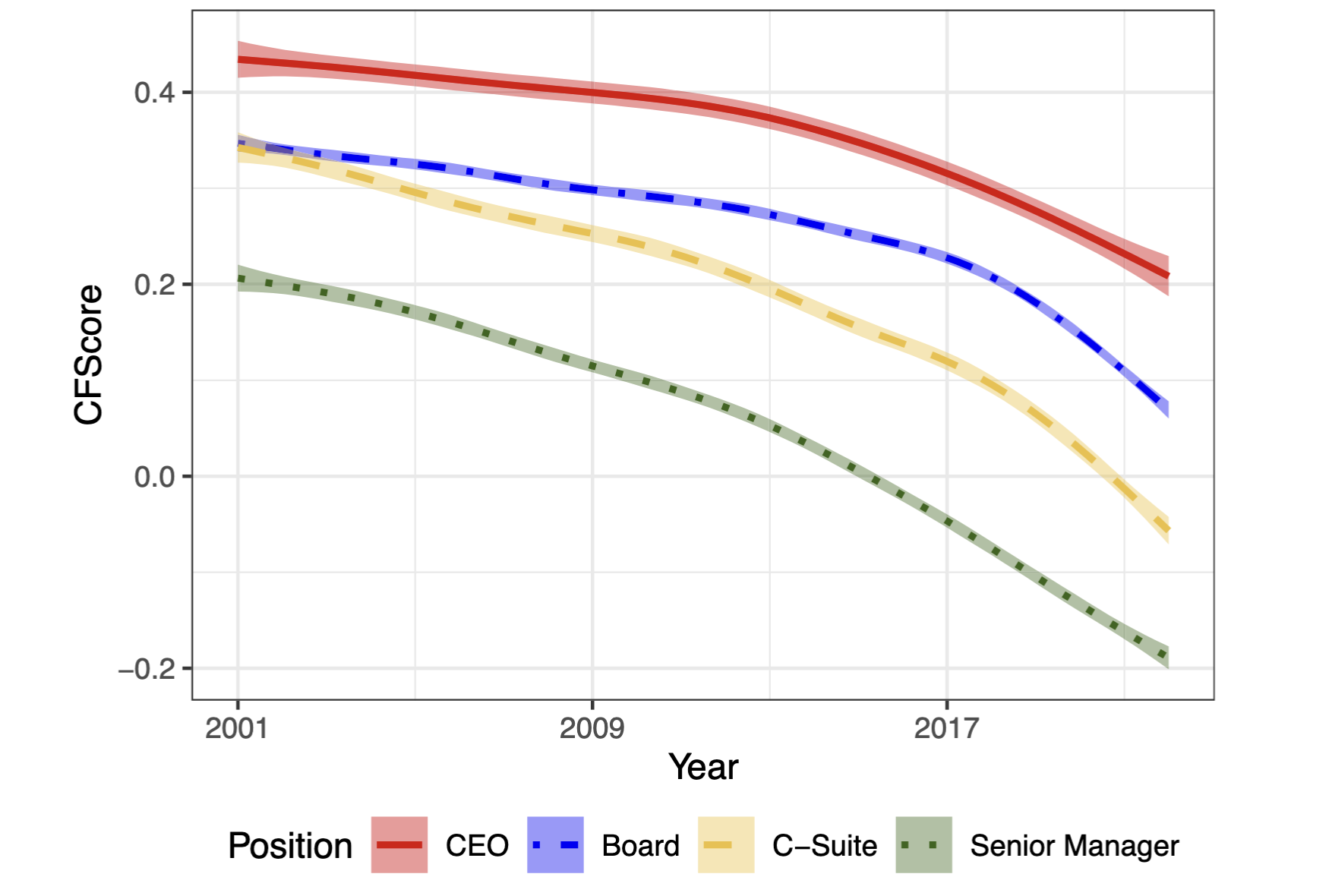
The figure above breaks it down by role, and the roles do diverge. CEOs skew the most conservative and senior managers the most liberal, but people across roles shifted left. Senior managers across corporate America went from roughly an even split to a strong liberal skew, and by the end of the period liberal groups of senior managers and C-suite executives outnumber conservative and moderate ones at the firm level.
Conservative CEOs still outnumber liberal ones. Boards started centre-right and now sit around the centre. But that isn’t to say these are universal patterns as industry differences remain. Unsurprsingly, given the stakes of climate change, energy remains a bastion of the right. And despite the last few years of the “Nerd Reich”, tech did continue to move to the left on the whole.
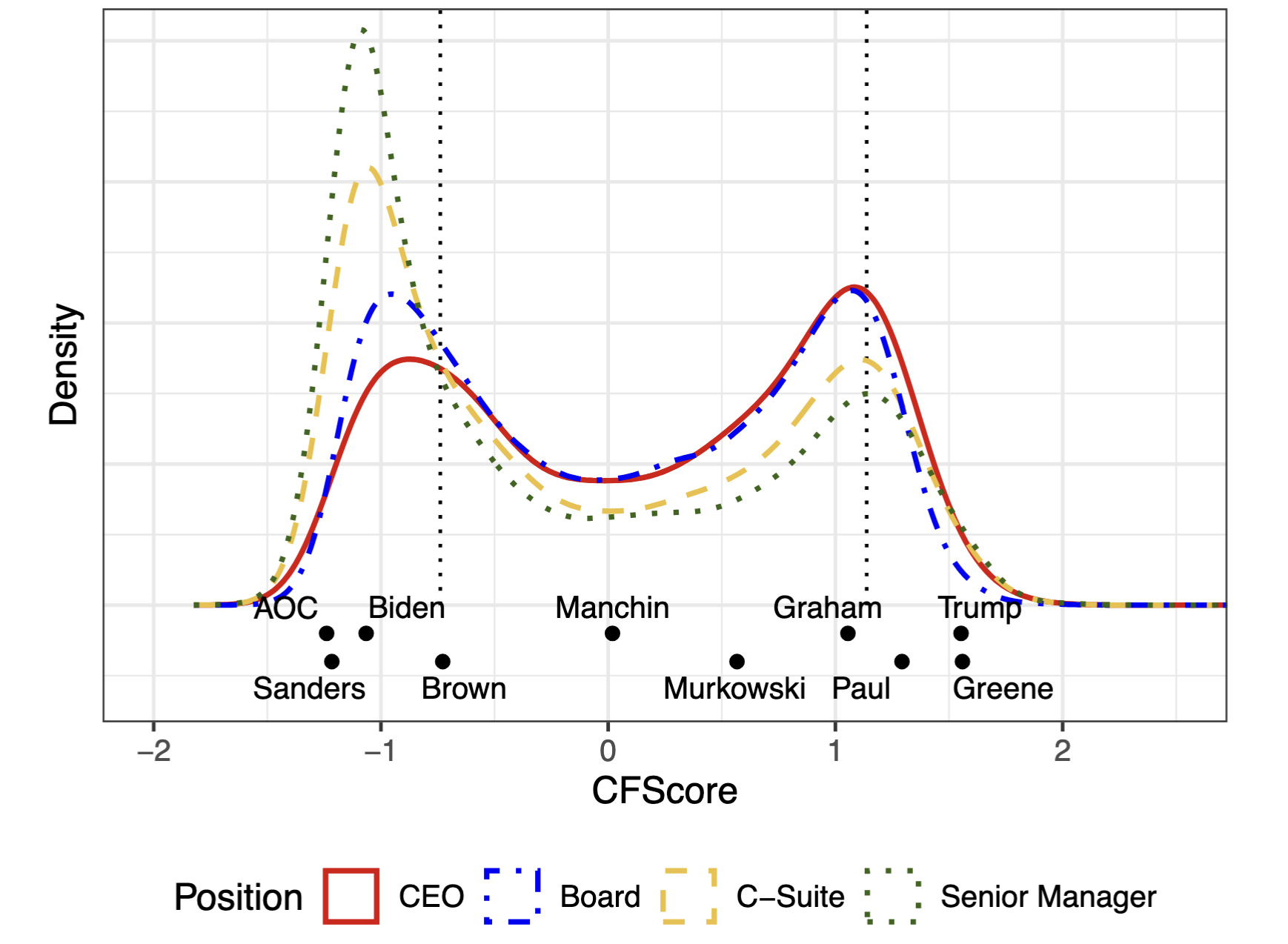
The ideology scores that Steel uses are the bread and butter of “American Politics” research, but it’s useful to anchor what they mean in the real world. The figure above plots recent distributions alongside well-known politicians, from Alexandria Ocasio-Cortez and Bernie Sanders on the left to Rand Paul, Donald Trump and Marjorie Taylor Greene on the right, with party averages for 2018 to 2022 congressional winners as dotted lines. The modal liberal senior manager leans toward the progressive wing of the Democratic Party (the median firm-level group of senior managers has a CFScore of -1.06), while the modal liberal CEO looks more like a mainstream Democrat.
Steel considers a range of factors that could have contributed to this leftward movement. Some of it can certainly be explained by the rising share of women and people of colour (who tend to be more liberal) among corporate elites. These days elites are also increasingly making their first donations while living in liberal areas. But roughly half the shift is explained by other factors. And the obvious causal story fails a test. Steel uses California’s board gender-diversity mandate in a difference-in-differences design. The law raised the number and share of women on boards, but it did little to the average ideology of those boards. Adding women, on its own, doesn’t make a board more liberal.
Nonetheless, the shift has had meaningful consequences. Firms with more conservative directors and executives are much less likely to take public stances supporting LGBTQ rights. For the most liberal firms the predicted probability of signing the Human Rights Campaign (a corporate statement on LGBTQ legislation) statement is around 60%, falling more or less steadily to 0% for the most conservative. To get closer to causation, Steel instruments a firm’s average ideology with the average at other firms in the same industry. That’s suggestive, not definitive, but it’s one of the few links in this literature between who’s in the room and what the firm says.
Even with these ideological shifts, firms continue to be strategic actors. How they spend their money is still largely dictated by the bottom-line and notions of “shareholder value” rather than a simple equation between employee preferences and campaign contributions. Caggiano and Rocco (2026) merge financial data on all publicly traded US companies (Orbis) with campaign finance records (the Center for Responsive Politics) and firm-level political risk scores (Hassan et al.), covering presidential campaigns from 1992 to 2020. On net, close to 90% of donating firms give to both parties.
The split, however, isn’t even. Firms consistently leaned Republican, especially those with higher solvency and longer operating histories, while research-intensive firms hedge more evenly. Larger and more profitable firms give more while polarization raises the stakes pf such giving. In the authors’ estimates a more polarized environment makes firms 2% more likely to donate and increases total contributions by about 21.8%, especially outside research-oriented sectors.
Corporate Political Sorting
So even as the elite appear to be moving left, their firms continue to feel the need to hedge. At one-level this is in keeping with a “purple” wave, but in a previous post I discussed the work of Zhao Li. She shows how employees do restrict PACs giving too much to “the other side” due to fears of a backlash. So to understand elite power we do need to look at the employee base as well.
Frake et al. (2026) merge administrative voter-file records with Revelio Labs data scraped from LinkedIn, covering over 45 million workers. The main analysis is a 2024 snapshot of 31 million workers, which is 30% of attempted matches, 19% of registered voters and 18% of the US workforce, plus a 2012 to 2024 panel. They argue this beats the usual proxy, donation records, since few workers donate and donors skew old, white and educated.
Partisans are segregated by workplace. The average Democrat’s coworkers are 11.7 percentage points more Democratic than the average Republican’s. That gap overstates it, since people also sort by place and profession, but after controlling for geography, industry and occupation it’s still 2.9 points, almost identical to the 2.8 points they get for gender. This matters because sorting by gender is legally restricted. Sorting by politics isn’t.
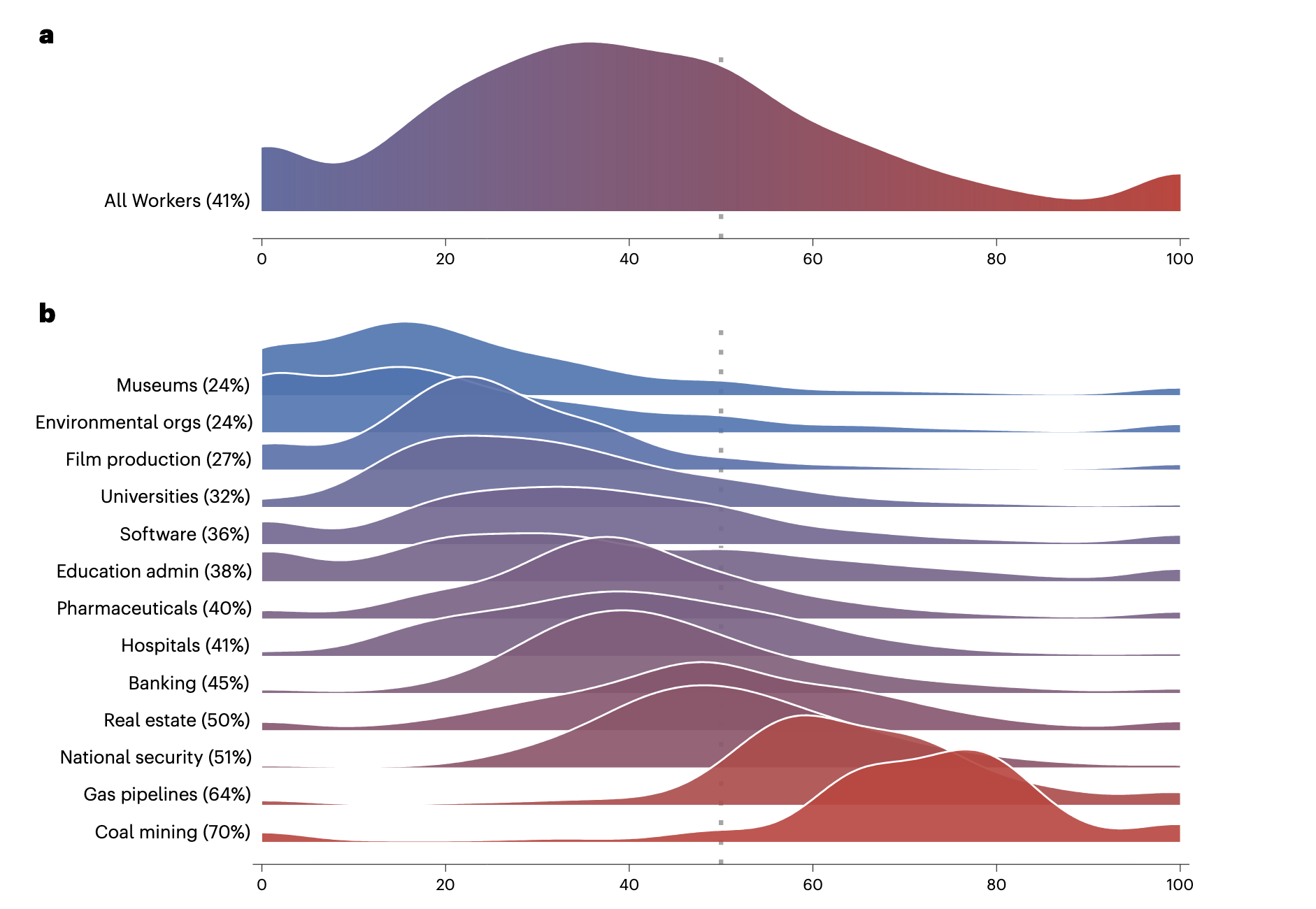
The ridge plots show how much of this runs through the type of work. Workers in museums and environmental organizations average only 23% Republican coworkers, while those in gas pipelines and coal mining average 64% and 70%. Among occupations, historians (22%) and social workers (26%) sit at one end, and pilots (65%) and drill operators (68%) at the other.
Sorting is strongest among the most political and the most powerful - 14.8 points among political donors versus 11.6 for non-donors, and 14.7 among senior executives. Republicans actually get more exposure to the other side, with the average Republican’s coworkers 50% Democratic against 32% Republican for the average Democrat, partly because Democrats are a larger share of workers. That's probably just due to age differences between the parties.
But it’s not changing all that much, unlike at the top. The gap was 11.1 points in 2012 and 11.0 in 2024, so the workplace has been sorted for at least a decade. Given general polarization trends, we certainly should not expect this to drop.
Elite Expectations
Most of these analyses were conducted in the early 2020s. We know that the country, electorally at least, lurched back to the right. In 2022. Hersh and Shah (2025a) surveyed “business elites” who were expecting the opposite.
The authors had the voter-file vendor Catalist identify registered voters in the wealthiest Census block groups (median household income of at least $250,000) who microtargeting data suggest are in the top 5% of earners nationally. They kept single-family homes with six or fewer registered voters, then took the oldest registered voter aged 35 to 65 at each address, to screen out retirees and juniors. That left 61,130 people in 26 states plus DC, more than half in New York, California, Connecticut and Texas, and the authors solicited 10,000. It isn’t the Fortune 500 C-suite, since it misses Manhattan apartments and unequal cities like Las Vegas, but it reaches wealthy business people in places like Salt Lake City, Miami and Redmond that a Fortune 500 donor list would skip. A comparison sample of the mass public came from the 2022 Cooperative Election Study (CES).
Here, unlike Steel, they weren’t after elites own politics. The questions targeted where they think business sits. Business leaders in every partisan group said the national business community, their state’s business community and their own company have all moved toward the Democrats over the last decade. The mass public didn't see the same pattern. Overall, the public was slightly more likely to say national companies have moved toward the Democrats and their own employer toward the Republicans. The exception is Republican identifiers, especially strong Republicans, who saw businesses (nationally above all) drifting toward the Democrats.
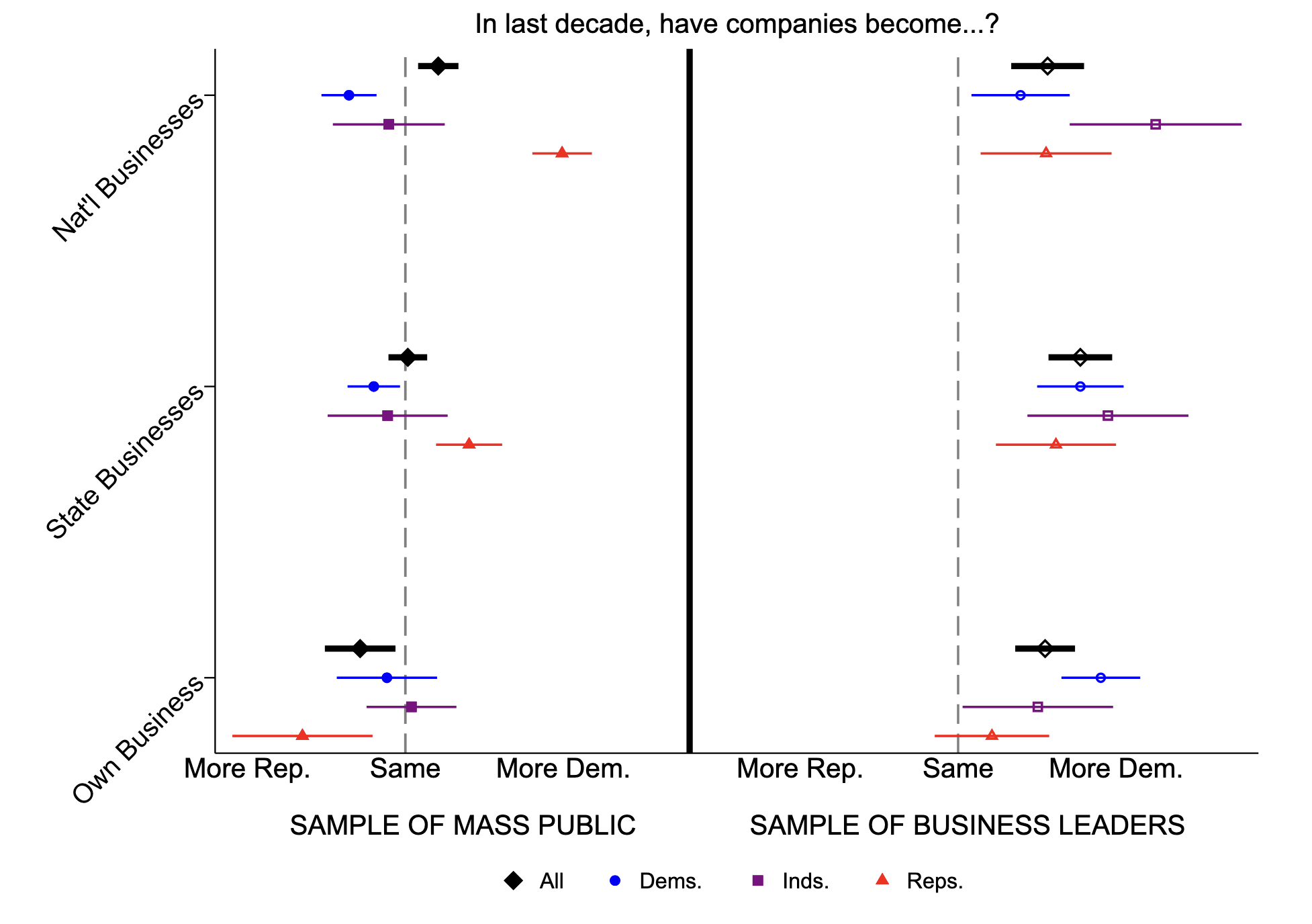
The figure plots perceived movement on a scale from -1 (toward Republicans) to 1 (toward Democrats), and the contrast is between the two halves. On the mass-public side the averages hover near zero (left panel), and the signal is hidden in the partisan split. On the elite side, every partisan group sits on the Democratic side for all three questions (N = 210, 215 and 195 for the national, state and own-firm questions), with Democratic leaders the most likely to see it at their own firms. The woke-capital story wasn't confined to strong Republicans and conservative pundits. The executives agreed with them on direction.
An obvious objection is that leaders may be projecting. Ask where their firm stands today and Democrats say Democratic and Republicans say Republican. But on direction of travel they agree, and a false-consensus story wouldn’t predict that.
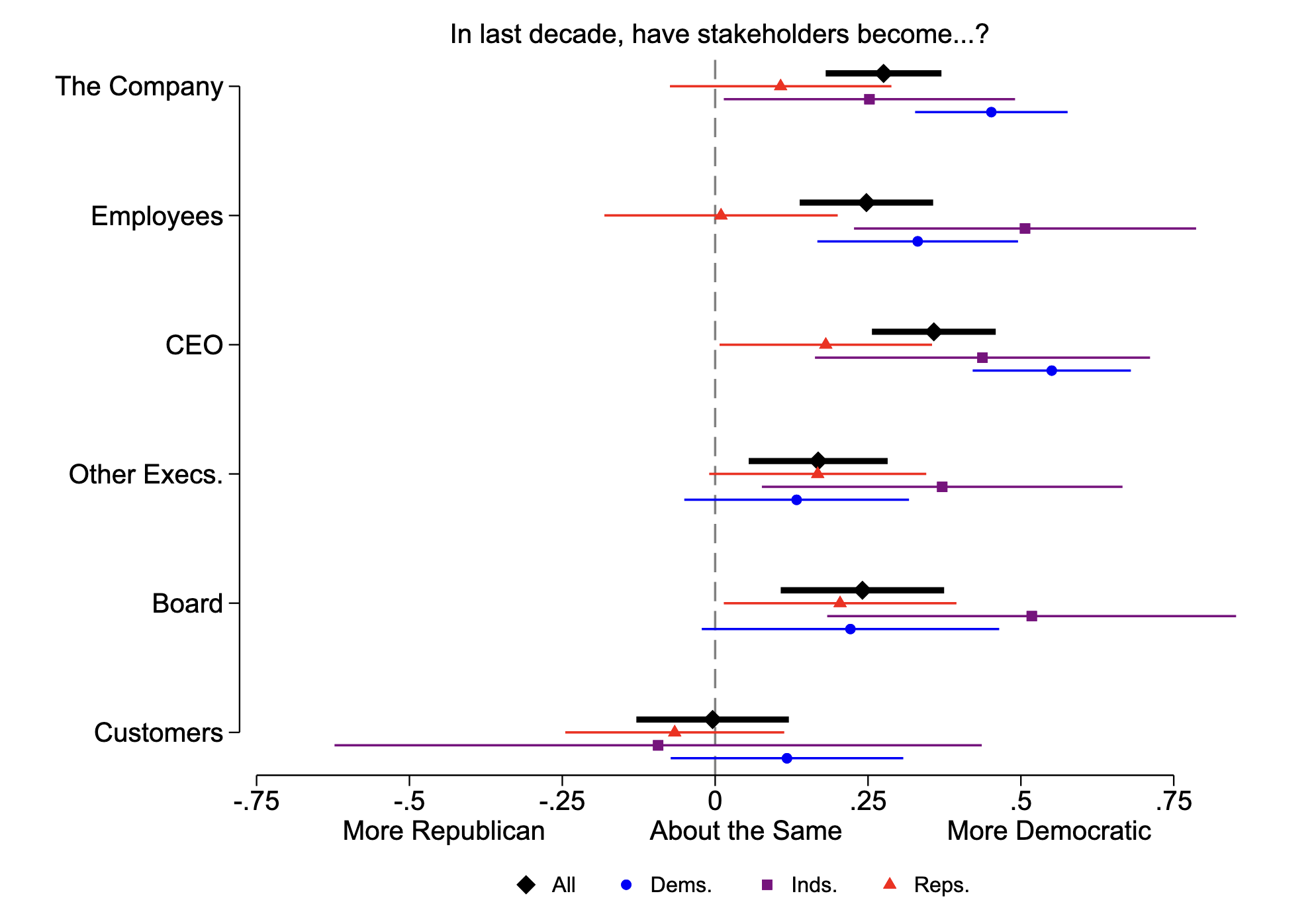
The stakeholder figure above shows what drives the perception. Companies overall are seen as leaning Democratic, driven by Democratic and independent respondents. CEOs and employees are seen as more Democratic-aligned, while other executives and boards look more neutral. When asked who is pushing the company, employees have the highest point estimate toward the Democrats – in keeping with Li and Farke et al. - but CEOs, other executives and boards are seen pushing in the same direction Customers are the only group not seen pushing at all. But it should be noted that most respondents don’t think any stakeholder is pushing all that hard.
The policy question is where the “cross-pressure” the authors care about should show up. The expectation from the corporate PAC literature is that firms care about the economy and regulation, which should align them with Republicans. And that holds for the 46% of respondents who named one of those two as their company’s top priority. Of those 101 business elites, 57% saw the company as aligned with Republicans on the issue and 15% with Democrats. Everyone else, 131 respondents who named something broader, split the other way, 64% Democratic and 9% Republican.
The two perceptions travel together. Three-quarters of those who see their firm as Democratic-aligned also see its core policy as Democratic, and 77% of those who see it as Republican say the reverse. Few leaders describe a firm that leans one way while its priorities lean the other. My read is that the shift is only partly about stakeholders. The leaders who see their firms moving left also describe different priorities.
Now put the leaders’ preferences together with all of that. Assuming, firms are moving left, in a follow-up piece, Hersh and Shah (2025b) ask what corporate elites want to do about it. They distinguish three normative camps. First, anti-corporate purists who think firms should stay out of politics entirely. Second, shareholder capitalists who think they should speak up only on policy that affects profits, and, finally, stakeholder capitalists who want a broader role.
Importantly, the mass public (the 1,000-person CES sample) mostly doesn’t want any of it. Low demand for corporate political engagement cuts across every partisan group, though Democrats are more interested than Republicans.
The elites differ sharply. A majority of business leaders of all political stripes say corporate leaders should be somewhat or very involved, more than twice the rate in the mass public. They want more engagement on the economy, and both Democratic and Republican elites overwhelmingly want their firms more engaged on the specific regulations that affect their work than on any broader issue. So Democratic leaders don’t want to swap lobbying for social causes - they want both.
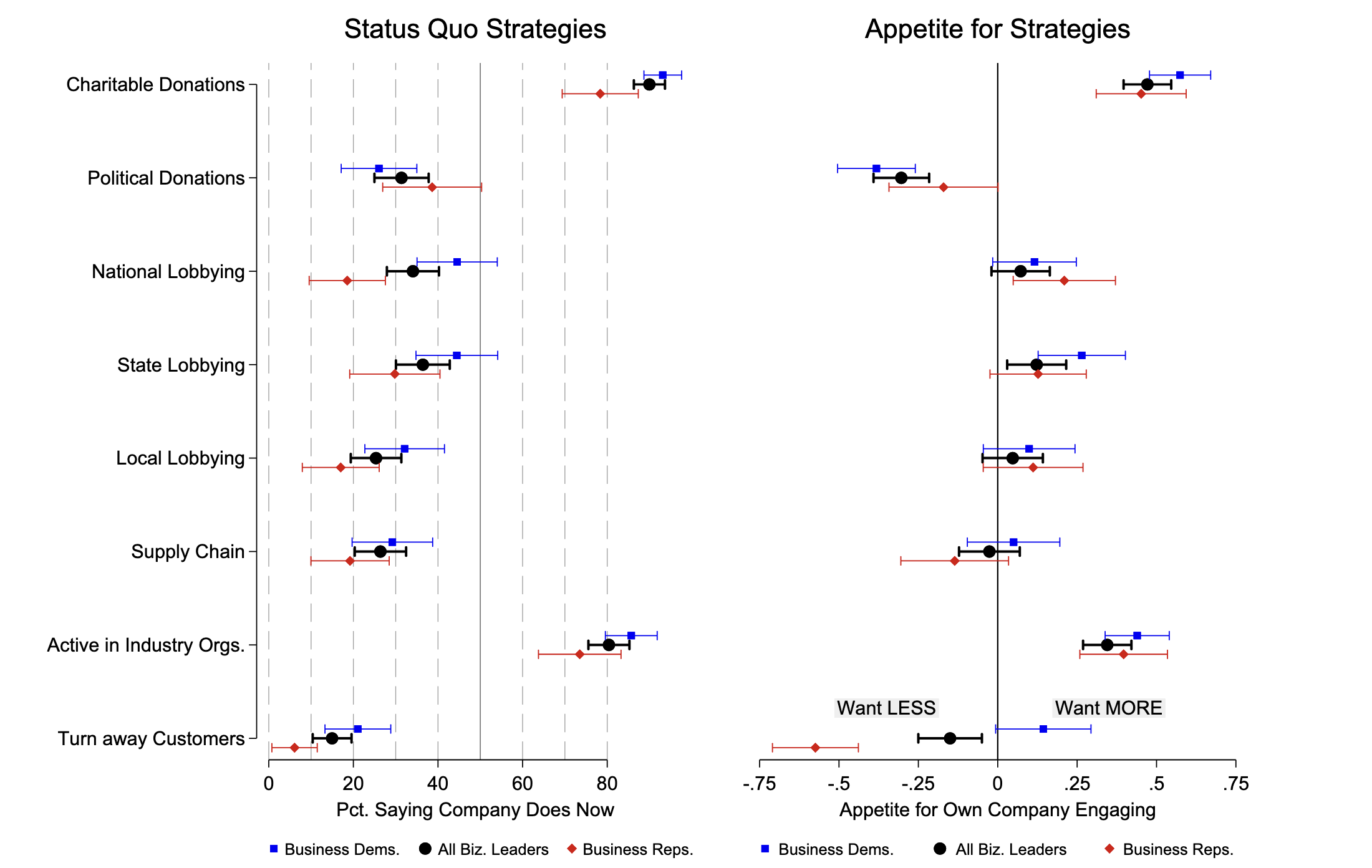
The figure above compares what firms do now with what leaders want more of. The status quo is concentrated in charitable donations and industry associations, with other activities claimed by 20% to 40% of firms. The appetite is mostly bipartisan in the form of more lobbying, more charitable giving, more work with industry groups. The one partisan divide is turning away customers whose values don’t match the company’s, which about 20% of Democratic business people say their firm’s leaders do now.
In other words corporate elites want quiet, behind-the-scenes advocacy, mainly through intermediary industry groups – which is line with what political scientists like Pepper Culpepper show to be most effective, and cuts against recent trends in American politics. Strategies that mobilize customers or workers are unpopular with elites of both parties. That sits uneasily with the surveys in my last post, where 46% of firms reported mobilizing their workers. Leaders say they’d rather not, but firms do it anyway – I take that as a sign of our polarized times.
From preferences to action
These are four different vantage points on the preferences and politics of the business elite that, on surface, create some contradictions. Looking at who sits in the boardroom, Steel finds directors and executives drifting from modestly conservative to roughly centrist between 2001 and 2022, about 42% of a standard deviation, mostly through turnover. Looking at the checkbook, Caggiano and Rocco find that close to 90% of donating firms still give to both parties, and that the split leans Republican. Looking at the workforce, Frake et al. find partisans sorted into different workplaces to a degree comparable to gender, and the gap was 11.1 points in 2012 and 11 in 2024. And asking leaders directly, Hersh and Shah find executives in every partisan group who say business has moved toward the Democrats, and who want their firms more politically engaged than the public does, so long as it’s done quietly.
My read is that reconciling these views requires thinking about rates of change across different parts of a business. People change slowly, through cohorts and turnover. Institutions change even more slowly still, and a firm’s giving strategy is set by lobbyists, PAC rules and the bottom line, not by the average opinion in the C-suite. So donations usually act as hedges while the room drifts. Leaders see a shift that the money hasn’t caught up with. That’s my interpretation, not a finding. None of these papers tests it directly.
One caveat. Every dataset in this post stops before the swing back to Trump and the recent 2026 midterm blowback. Steel ends in 2022, the elite survey was fielded in 2022 and Frake’s snapshot is from 2024. Nothing here can tell us whether the broligarch moment reflects the median firm or only its loudest members. If it’s the median, the hedging should come back. If it’s just the loudest - as I roughly expect - they've got a target on their back
This post is really about where the firm sits. The next one goes inside and asks what happens when the people in it disagree.